Tuesday, November 30, 2010

Mother Reunited with Daughter: Chicago Daily Law Bulletin Follow-up

A blog reader noticed an entry in the Chicago Daily Law Bulletin image I included in a previous post that referred to "People ex rel v Superior of House of the Good Shepherd" and wondered about the details of the case. I decided to follow up and obtained a copy of the file.

It seems a writ of habeas corpus was filed by a man named Miles Martin on behalf of a child named Sylvia Lear who was living at House of the Good Shepherd as Minnie Bell Pursell. According to the document, "Sylvia was some years ago stolen from her mother and the parties who took her have since died and the child falling into other hands, at last was placed in said House of the Good Shepherd to avoid the care and Expense of providing for such child."

The petition continued: "...the mother of said Sylvia after diligent Search and Enquiry for her child she having the only lawful right and custody to the care Custody and Education of said child, at last found out, that her said daughter was confined in said House of the Good Shepherd and that she demanded her said child of the Mother Superior of said Institution and was refused as well that she might see [her?] child at all."

The judge wrote "Let the writ of habeas corpus issue pursuant to prayer of within petition." It was dated Jan. 3, 1880 but the year was actually 1881.

Reading through the document, I wondered about Sylvia. Who was she? What happened to her? I checked the Chicago Birth Registers, 1871-1915 at FamilySearch's Record Search thinking she might have been born in Chicago but no good match turned up. Then I checked the Cook County marriage index to 1920 thinking she might have stayed in Chicago and married, but no luck.
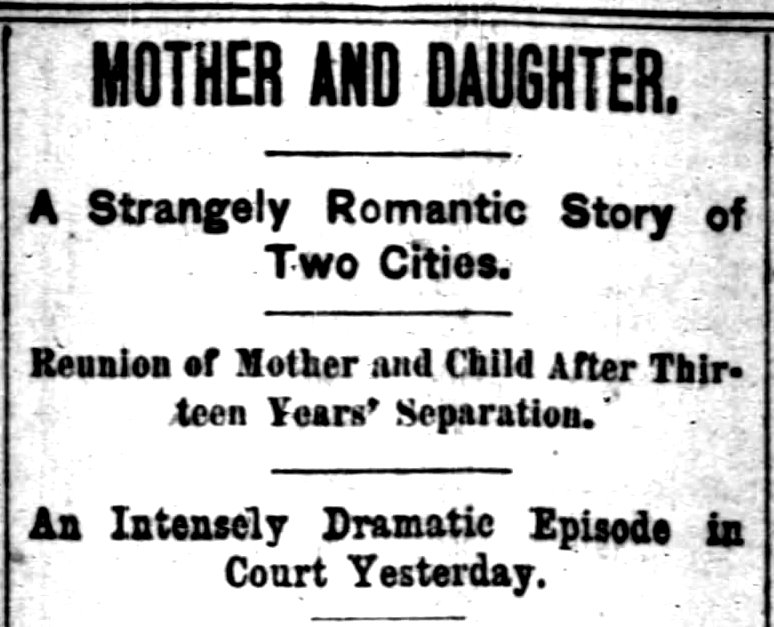
Then, I tried a search for "sylvia lear" in the Chicago Tribune at Footnote.com and found one match from 5 January 1881. I thought it would be a quick mention of the case in a legal column but the headline read "Mother and Daughter. A Strangely Romantic Story of Two Cities. Reunion of Mother and Child after Thirteen Years' Separation. An Intensely Dramatic Episode in Court Yesterday."

The lengthy report details the story of a young Peoria Christmas bride waiting for a groom who never came. Seven months later, July of 1868, she gave birth to a "female child" who was named Sylvia Lear and given to her married sister to raise. Four years later the young bride learned from her dying sister that the child had been left at a hotel in Peoria because her husband was unwilling to provide support. The baby was given to a woman named Ellen Kirby, who married Sanders, and later married Purcell. Mr. Purcell died. Mrs. Purcell died, and Sylvia ended up at House of the Good Shepherd. The story includes many more details than I have summarized her and it's worth taking the time to read it. Article Image

Sylvia's mother's name isn't mentioned beyond "Carrie" and "Mrs. W" in order to protect her privacy and, for the moment anyway, I think I will respect that. Still, I wonder what became of Sylvia Lear?

Monday, September 20, 2010

Restoration of Pre-fire Naturalization Records

38163 Petn of D H Schwahn to restore record of naturalization

In a previous post, I mentioned finding the entry above in an 1881 Chicago Daily Law Bulletin and I promised to follow up. I asked the Circuit Court Archives to have the file brought in from the warehouse and I returned to view it last Friday.

The file held no surprises. Mr. Schwahn naturalized in 1865 and all record of his naturalization was destroyed in the Chicago fire in 1871. He petitioned the court to have the record restored and it was.

So, what do we learn from the documents? First, that Mr. Schwahn was very likely naturalized, as stated, on or about 1 November 1865. Second, that he had "resided within the limits and under the jurisdiction of the United States for and during the full term of five years last preceding said 1st day of November" and "more than one year immediately preceding the said date in the State of Illinois." We also learn that he renounced allegiance to "the Emperor of Germany whereof he was heretofore a subject." In other words, we learn that he was from Germany and that he arrived in the United States 1860 or earlier. We also learn that nearly twenty years after he was naturalized he had reason or desire to have note of it restored to the Court records. In some cases, this information might provide valuable clues to follow up on.

A typescript of the document is given below.

- - - - - - - - - - - - - - - - - - - - - - - - - - - - - - - - - - - - - - - - -

In the matter of the petition of }
D.Henry Schwahn for the restoration } Petition
of the record of his naturalization }
as a Citizen of the United States }

And said matter having come on this day to be heard upon the petition filed herein, and upon proofs, and evidence heard in open Court and it appearing to the Court therefrom, the Court finds:

That on or about the first day of November AD 1865 said petitioner appeared in this Court and showed to the Court that he had resided within the limits and under the jurisdiction of the United States for and during the full term of five years last preceding said 1st day of November and more than one year immediately preceding the said date in the State of Illinois, and that during said term of five years, he had sustained a good moral character, and appeared to be attached to the principles contained in the Constitution of the United States and well disposed to the good order, well being and happiness of the same, and that two years and upwards had elapsed since said petitioner filed the declaration of his intention to become a citizen of the United States, according to the provisions of the several acts of Congress heretofore passed on that subject.

That thereupon said petitioner in open Court took and subscribed he oath required by the laws of the United States, to support the constitution of the United States and to renounce and abjure all allegiance and fidelity to every foreign Prince, Potentate, State or Sovereignty whatever, and more particularly all allegiance which he in any wise owed to the Emperor of Germany whereof he was heretofore a subject.

That thereupon an order was entered by this Court finding all the foregoing facts, and ordering that the said petitioner be, and he was thereby admitted to all and singular the rights, privileges and immunities of a naturalized citizen of the United States, and that it be certified to him accordingly.

That thereupon a certificate of such naturalization was issued to said petitioner out of this Court under the seal thereof and signed by the Clerk of this Court.

That afterwards and on the 9th day of October 1871 the records of this Court including the record of the said order, and also the said certificate of naturalization issued to said petitioner were totally destroyed by fire without the fault or neglect of said petitioner and that said defect cannot be supplied by any certified copy of said order or certificate, and the loss or destruction thereof, unless supplied, may result in loss or damage to this petitioner.

That the substance of said order was as herein before set forth

And the Court being now fully advised in the premises, it is ordered adjudged and decreed by the Court that the substance of the said order of naturalization as herein above set forth, be and the same in hereby restored of record.

Sunday, August 29, 2010

McCoy Brothers Gravestone Benefit Concert

There's something you should know about me before you read this post. If I had all the time and money in the world, I would sit around all day alternating between two things: genealogical research and playing my fiddle. Well, maybe three things. I'd probably need a bit of chocolate to keep me going.

I like history. Chicago history. And I like music. And when something captures those things together, it catches my eye.

A few weeks ago I learned that there will be a benefit concert at the Old Town School of Folk Music on Sunday, October 3, to raise money to purchase gravestones for the McCoy brothers, Chicago musicians who died in 1950 and were buried in unmarked graves. I thought I'd help get the word out. There will also be guitar, mandolin, and body percussion workshops and a walking tour of the Restvale Cemetery that day.


I don't know much about the McCoy brothers--only what I read at the tribute website--but I like them. I like that music was their passion. And I like that there are people who value their music and want them to be remembered.

If you can't make the concert, consider donating a few dollars to a good cause.

Friday, August 20, 2010

Exploring the Chicago Daily Law Bulletin: Part I


A couple of weeks ago I was searching microfilm indexes at the Circuit Court Archives looking for a divorce entry and I came on some pages that I found close to impossible to read. The writing was small and faded and I had to give up. Unfortunately, I didn't find the divorce in any of the other years I looked at and so the search is hanging.

And soon after, I met a Family History Center patron who has been unable to find a naturalization petition for his grandfather. It's possible the process was never completed but the researcher isn't ready to give up.

In both cases I wondered if there might be an alternate way to search for court records, and the Chicago Daily Law Bulletin came to mind as a possibility. I learned, some time ago, that it's a good way to search for adoptions (see this post and I wondered if it might be a good tool to use to search for divorces and naturalization records, too.

I was able to find one copy of the Bulletin online at Google Books. It's from 1881.

I haven't looked at earlier or later volumes and so I don't know if this one is representative of all of the volumes or just those published in the 1880s, but I'm guessing the information is similar.

So, what's in it?

The first page includes the upcoming day's calendar for the following courts:

Superior
Circuit
Appellate
County

The District Court is also mentioned later in the volume.

The calendar is followed by lists of cases arranged by court. Headings include

New Suits
Judgments
Miscellaneous Orders

And there are specific mentions of bankruptcy, chattel mortgages (deferred payments on furniture and musical instruments), bills of sale, and trust deeds, mortgages, general assignments. I even stumbled on an adoption in the County Court.

Petn of W B Engel et al to adopt child

Divorce cases are listed and the entries could serve as an alternate index. Here ar some example entries:

37111 Linns B Bentley v Lucy Bentley. Bill for divorce. H F Vallette solr.

36995 Meiter v Meiter. Ord for deft to pay $50 solrs fees and $8 per mo alimony.

I believe the number in front of the entry could be used to order the file in from the warehouse at the Circuit Court Archives.

Unfortunately, it's hard to tell if naturalizations were routinely listed. I searched using variations of "petition" and "naturalization" and came up empty handed except for five entries to restore records.

38163 Petn of D H Schwahn to restore record of naturalization

I'm curious to know what these cases were about and I will try ordering in a file the next time I go downtown. I'll also try to find an index entry for an 1881 naturalization so that I can see if mention of it appears.

Watch for "Exploring the Chicago Daily Law Bulletin, Part II." And in the meantime, if you have a few minutes, you might want to explore the Bulletin on your own. If you find something interesting, please post a comment.

Saturday, August 14, 2010

Illinois Statewide Deaths Indexed a FamilySearch

FamilySearch's Record Search continues to grow and yesterday (August 13) a new series was added. The title is Illinois, Deaths and Stillbirths, 1916-1947 and the description reads "Name index of deaths and stillbirths in Illinois, 1916-1947. Includes records for Cook County and Chicago." The corresponding images don't seem to be online but the index provides a wealth of information (if listed on the record) including birth date and place, parent names and birth places, spouse name, burial date and place, and occupation.

If you want a copy of the actual record I will continue to offer access to the Chicago records (and some Cook) unless they go online for free and you can get the statewide death records from Molly Kennedy. (See "Lookups Available")

You can also order the films through any Family History Center. The cost is $5.50 + any notification fee a center might add and the reels usually arrive in about 2-4 weeks depending how often a center orders and whether or not a film is on backorder.

If you find a Chicago/Cook record, 1916-1922 listed in the statewide index, you should check FamilySearch's Illinois death certificates and stillbirths, including Chicago, 1946-1947 to see if the image is available there. Between 1916 and 1922 there should be some overlap in the two databases. Note the subtle differences between two entries for the same death.


Collection: Illinois, Deaths and Stillbirths, 1916-1947
Note: Image not online
Name: Thomas A. Bielby
Titles and Terms (original):
Death Date: 21 Aug 1916
Death Place: Chicago, Cook, Illinois
Gender: Male
Marital Status:
Race or Color:
Age: 42
Estimated Birth Year: 1874
Birth Date:
Birthplace: Chicago, Ill
Father: Thomas W. Bielby
Father's Titles and Terms (original):
Father's Birth Place: New York
Mother: Catherine Reordan
Mother's Titles and Terms (original):
Mother's Birth Place: Ireland
Occupation: switchman
Residence: Chicago, Cook, Illinois
Street Address:
Spouse:
Spouse's Titles and Terms (original):
Spouse's Birthplace:
Burial Date: 24 Aug 1916
Burial Place: Chicago, Cook, Illinois
Cemetery: ...
Informant:
Additional Relatives:
Digital Folder Number: 4152370
Image Number: 1603
Film Number: 1852282
Volume/Page/Certificate Number: 24078
Collection: Illinois, Cook County Deaths, 1878-1922
Note: Image online
Name: Thomas A. Bielby
Titles & Terms:
Death Date: 21 Aug 1916
Death Place: Chicago, Cook, Illinois
Gender: Male
Race (Original): W.
Race (Standardized): White
Death Age: 42y 6m
Estimated Birth Year: 1874
Birth Date:
Birthplace: Chgo., Ill.
Marital Status:
Spouse:
Spouse's Titles & Terms:
Father: Thomas W. Bielby
Father's Titles & Terms:
Father's Birthplace: New York
Mother: Catherine Riordan
Mother's Titles & Terms:
Mother's Birthplace: Ireland
Occupation: Switchman
Street Address: 346 N. Lockwood Ave.
Residence:
Cemetery: Lyonsville Cem.
Burial Place:
Burial Date: 24 Aug 1916
Funeral Home:
Informant:
Additional Relatives:
Film Number: 1276305
Digital Folder Number: 4004836
Image Number: 690
Reference Number: cn 24078

Census Search: City Directory Approach

Recently, I wanted to find a family in the 1900 census. I was told that they lived at 708 Melrose from 1896-1903 and so, theoretically, they should have been enumerated at that address. (I double-checked the 1896 and 1901 city directories and that was the address given.) Unfortunately, a name search of the 1900 census yielded no match.

It's possible to the maps at A Look at Cook to determine the enumeration district in order to page through a census, but it's also possible to use a neighbors approach now that the Chicago city directories are online and searchable at Footnote.com.

In this case, I searched the 1901 directory by address (708 Melrose, 706 Melrose, etc.) looking for a name that I thought would easily appear in the census index at Ancestry.com. (Note: It's important to put the search terms in quotes, e.g., "704 Melrose") Carl Schmidt at 706 Melrose was a possibility but the name was too common. Eventually, I found Richard E. Pause at 702 Melrose and I was able to easily locate him in the census. Scrolling down the page, the entries jumped from 704 to 710 making it appear that 706 and 708 were skipped.

I followed a similar approach to locate the odd numbers for the same street thinking that perhaps the entries were made out of order. This page shows 707, 709, and 711.

I'm thinking it's possible that the families living at 708 Melrose were, indeed, skipped, but why? I notice in the 1900 city directory that there's a business listing for Bruno Rohden (stove repairs) at 708 Melrose. Is it possible that 708 Melrose was a storefront and that the enumerator didn't check to see if anyone was residing at that address?

What do you think?

Saturday, August 07, 2010

Researching Polish Ancestors? New Translation Guide Available

I've volunteered at the Wilmette Family History Center for a number of years and one of the perks in serving there is the chance to meet many talented and downright-pleasant-to-get-to-know researchers. Judith Frazin is one of them. She's the author of A Translation Guide to 19th-Century Polish-Language Civil-Registration Documents
(including Birth, Marriage and Death Records)
and the newest edition of the book recently won her an achievement award from the International Association of Jewish Genealogical Societies.

If you are researching Polish ancestors, as many people who have Chicago roots are, take some time to explore this book!

Sample pages including table of contents

Check WorldCat to see if there's a copy available at a library near you. (The Wilmette FHC has one, if you're in the area.) If not, you can order it through the Jewish Genealogical Society of Illinois website.

Using the Family History Library Record Lookup Service

Have you heard about the Family History Library Record Lookup Service? It's a very convenient way to obtain digital copies of Chicago vi...