Showing posts with label Indexes. Show all posts
Showing posts with label Indexes. Show all posts
Wednesday, September 13, 2017
Celebrating Digital Access: Chicago Delayed Birth Index
Today I'll focus on the Chicago Delayed Birth Index that's newly available in digital format through the FamilySearch Catalog. You can view the index images if you visit a family history center or FamilySearch affiliate library; you won't be able to view the images from home. And, you may be able to find the matching records online, too.
First, a little bit of background.
For those of you who are unfamiliar with delayed birth registration, it was a way of creating a civil birth record, sometimes long after the birth, when an original wasn't filed at the time of the event. It's particularly relevant to Chicago research because many early births went unreported.
Many of the entries in this index are for records that were recorded in the 1940s. Why? One reason might have been that people who were going to work for the war effort needed to be able to prove their citizenship. [1]
So, when should you use this index?
Checking this index is a good next step when you've searched the "regular" birth indexes and come up empty-handed. Why? Because an unsuccessful search for a birth certificate can mean two things--the birth wasn't reported or the name, for whatever reason, just isn't popping out of the index. If you find a match in this delayed birth index, then it's likely the birth wasn't reported at the time of the event and you can feel comfortable giving up the search for a record that likely doesn't exist.
And what should you know about searching it?
Just one thing. Surnames aren't listed in strict alphabetical order and it isn't sorted by given name. If you are search "Smith," you will have to look through many pages. The good news is years appear to cluster and you can use that to quickly skim through irrelevant entries. Take a good look at this example page to see what I mean.
In the past, I've suggested people contact the Cook County clerk's office to obtain copies of these record. However, it appears that at least some of the matches are included in the newly-digitized Cook County records that are available on at FamilySearch and their online index may duplicate this delayed birth index meaning--you may not have to use this index at all! For more information and a tutorial on how to find the records on FamilySearch, please watch the video at the top of the post.
__________
[1] Alfred A. Worzala, "Your Social Security: How to Prove Citizenship," Chicago Tribune, 15 November 1970, sec. 5, p. 11, col. 1; digital image, Chicago Tribune Archives (http://archives.chicagotribune.com/1970/11/15/page/145/article/your-social-security : accessed 13 September 2017).

Celebrating Digital Access: Chicago Death Index, 1871-1933
 |
| Sample Image from the Chicago Death Index, 1871-1933 [1] |
First up is a multi-volume set titled [deep breath] Indexes to deaths in the city of Chicago during the years 1871 to 1933 : showing name, address and date of death. I just call it "the Chicago death index, 1871-1933" or "the CDI" for short. One thing you should know about it right up front is that the title is a bit misleading. It mostly lists Chicago deaths, but it also includes some out-of-town deaths--entries for people who died outside the city but were probably brought to Chicago for burial.
1) When you're looking for deaths 1871-1877. As far as I know, this is the only public index that covers the early deaths. If you find a match, contact the Cook County clerk's office. My husband's ancestor appears and I was able to get the matching death record in that way. Looking at what I received, I'm pretty sure someone copied information from a death register onto a blank form. (As far as I know those death records aren't available anywhere else, but if you know differently, please let me know.)
2) When you can't find a name in any of the online indexes. Two reasons. First, the name might be spelled differently in this index, making it easier to pick out. Second, this index includes entries for people who died outside Chicago but were buried in the city. That Chicago ancestor may have died on vacation in Michigan--seriously--and this index is a good way to work around the unexpected. Out-of-town deaths are indicated by the "OT" in the column just before the date of death. If you find one of those entries, it's best to contact the vital records office where the death took place to see if you can get an original record. However, if the death occurred 1909-1915, the matching Chicago records (likely derivative) are available at FamilySearch. See Out of town deaths, 1909-1915.
3) When you're trying to find a record for someone with a common name. This index includes address of death so, if you know where your John Smith lived and if he died at home, which was often the case, it will be very easy to pick him out.
4) When you're looking for mention of a stillbirth. Stillbirths are indicated by the "SB" in the column just before the date of death. I haven't explored how to find the matching records, but I can tell you two things: 1) some stillbirths are recorded in the birth registers at the end of each alphabetical section; 2) many new stillbirth certificates appear to be online at FamilySearch, accessible through the catalog.
5) When you're looking for children who died but you don't know their names. Sometimes it's possible to pick out possible matches based on a known family address. So, when should you use this index? If you find matches, for deaths 1878-1933, follow the usual steps for finding those certificates. And, if you find yourself stumped, feel free to email me for help: info@chicagogenealogy.com.
__________
[1] Chicago Board of Health, Deaths in City of Chicago During the Years 1871-1933 Inc. Showing Name, Address, and Date of Death, Volume 27, Rid-Rzy ([no publishing information]); digital image, FamilySearch (https://www.familysearch.org/search/film/004261176?cat=293534 : accessed 12 September 2017); Indexes to deaths in the city of Chicago during the years 1871 to 1933 : showing name, address and date of death > Deaths, Rep-Sik 1871-1933 > Image 54 of 929; citing FHL microfilm 1295973.
Friday, December 13, 2013
Guide to Online Birth Indexes for Cook County: Which Ones to Use When (with links)
Handy Links to the Indexes Mentioned in this Post
Cook County Birth Registers, 1871-1915 (FamilySearch)
Cook County Birth Certificates, 1878-1922 (FamilySearch)
Cook County, Illinois, Birth Certificates Index, 1871-1922 (Ancestry)
Cook County, Illinois Birth Index, 1916-1935 (Ancestry)
Historical Cook County Illinois Vital Records (Cook County Clerk)

This is the last of a series of three posts focusing on the Chicago and Cook County vital records indexes that are available online. In this article, I'll give you links to the Cook County birth indexes that I use regularly and summarize their strengths and limitations to help you decide which one(s) will work best for your search.
Once you've found an index entry, the records can be obtained from a number of different places but the rule of thumb is this:
Quick Advice: Use this index if you're looking for births from 1871-1877. The birth register pages are the only records that are available for this time period (no certificates before 1878). Be aware that many of the entries lack given name(s) for the child so you might need to search on parent names.
If you're looking for records from 1878 forward, search the Cook County Birth Certificates, 1878-1922 first. It leads to certificates. If you can't find a match there, then check this index because names might be transcribed differently. If you find a match in this index, the birth register number can be used to find the certificate.
Quick Advice: Start with this index. If you don't find a match for a child, search parent names instead. If you still can't find a match for births up through 1915, try searching the birth register index linked above.
Quick Advice: This index overlaps the two FamilySearch indexes listed above and it doesn't provide certificate numbers or distinguish between birth register entries and birth certificate entries. It's best to use the FamilySearch indexes first.
Strengths:
Quick advice: Use this index if you need records from 1923 forward or if you are planning to purchase records from 1916-1922 from the County instead of getting them from FamilySearch films.
Quick advice: The search capability on this site seems to be limited to exact spellings within a year range. Create a free account on this site but use the 1916-1935 index at Ancestry.com to search (see above). This approach offers more flexibility and lets you easily click through to purchase and download records from this site.
Cook County Birth Registers, 1871-1915 (FamilySearch)
Cook County Birth Certificates, 1878-1922 (FamilySearch)
Cook County, Illinois, Birth Certificates Index, 1871-1922 (Ancestry)
Cook County, Illinois Birth Index, 1916-1935 (Ancestry)
Historical Cook County Illinois Vital Records (Cook County Clerk)

This is the last of a series of three posts focusing on the Chicago and Cook County vital records indexes that are available online. In this article, I'll give you links to the Cook County birth indexes that I use regularly and summarize their strengths and limitations to help you decide which one(s) will work best for your search.
Once you've found an index entry, the records can be obtained from a number of different places but the rule of thumb is this:
- get records from 1923 forward from the the Cook County Clerk's Office ($15 + a handling fee if you buy the records online at www.cookcountygenealogy.com)
- get records from 1871-1922 from Family History Library microfilm (the cost of a photocopy if you have local access to the films; $7.50 if you need to order a film from the FamilySearch catalog and have it sent to your local Family History Center); or from me through Genlighten ($6.00 each with quick turnaround; discounts for batch orders)
Cook County Birth Registers, 1871-1915 (FamilySearch)
Quick Advice: Use this index if you're looking for births from 1871-1877. The birth register pages are the only records that are available for this time period (no certificates before 1878). Be aware that many of the entries lack given name(s) for the child so you might need to search on parent names.
If you're looking for records from 1878 forward, search the Cook County Birth Certificates, 1878-1922 first. It leads to certificates. If you can't find a match there, then check this index because names might be transcribed differently. If you find a match in this index, the birth register number can be used to find the certificate.
Strengths:
- can be searched using combinations of child's name, parent names, gender, race, birth year range, and parent birth places
- * can be used as a wildcard
- search results show birth dates and parent names
- entries provide FamilySearch film numbers
- the Reference IDs provide volume and page numbers needed to find matching entries
Limitations:
- reference IDs are inconsistent (some provide volume and page; some provide page and line number)
- in most cases you'll have to look at the register page to get the certificate number needed to find the matching birth certificate (1878 forward)
- if a name is misspelled, especially the first few letters, it might be hard to bring up the matching entry
Additional Information: It seems likely that birth information was copied from certificates onto the register pages in the order that the clerk's office received them and that certificate numbers were assigned based on the line numbers in the register. If you have a choice, get a copy of the birth certificate rather than the register pages.
Cook County Birth Certificates, 1878-1922 (FamilySearch)
Quick Advice: Start with this index. If you don't find a match for a child, search parent names instead. If you still can't find a match for births up through 1915, try searching the birth register index linked above.
Strengths:
- can be searched using combinations of child's name, parent names, gender, birth year range, and parent birth places
- * can be used as a wildcard
- search results show birth dates and parent names
- entries provide FamilySearch film numbers and certificate numbers (Reference ID)
Limitations:
- if a name is misspelled, especially the first few letters, it might be hard to bring up the matching entry
Cook County, Illinois, Birth Certificates Index, 1871-1922 (Ancestry)
Quick Advice: This index overlaps the two FamilySearch indexes listed above and it doesn't provide certificate numbers or distinguish between birth register entries and birth certificate entries. It's best to use the FamilySearch indexes first.
Strengths:
- combines the two FamilySearch indexes listed above
- entries include FamilySearch film numbers
- entries can be saved to Ancestry trees
Limitations:
- entries don't include certificate numbers
- searches bring up entries for birth register pages and birth certificates; the only way to tell them apart is to check film numbers in the Family History Library Catalog or to find matching index entries at FamilySearch
- no links available for purchasing the matching records through the county clerk's website
Cook County, Illinois Birth Index, 1916-1935 (Ancestry)
Quick advice: Use this index if you need records from 1923 forward or if you are planning to purchase records from 1916-1922 from the County instead of getting them from FamilySearch films.
Strengths:
- can be searched using the child's name and birthdate
- provides file (certificate) numbers
- provides links to purchase records online from the Cook County Clerk's website
Limitations:
- database doesn't include parents which limits search possibilities and makes it hard to find matches for common names
- doesn't provide film number for the records from 1916-1922 that can be obtained from FamilySearch films
cookcountygenealogy.com (Cook County Clerk)
Quick advice: The search capability on this site seems to be limited to exact spellings within a year range. Create a free account on this site but use the 1916-1935 index at Ancestry.com to search (see above). This approach offers more flexibility and lets you easily click through to purchase and download records from this site.
Strengths:
- search results include children's names and birth dates
- database includes records 75 years and older
- records are available for immediate purchase and download
Limitations:
- must create an account and log in before searching
- can only be searched using exact spellings
- searches can only be limited by a date range
- doesn't include early birth records and may not include recently-released records
- database doesn't include parents which limits search possibilities and makes it hard to find matches for common names
Additional Information: Birth certificates are available if they are 75 year or older but the online collection is, to the best of my knowledge, incomplete. If you can't find what you need online, you can mail in a search request using the Genealogy Record Request Form.
Thursday, October 31, 2013
Guide to Online Marriage Indexes for Cook County: Which Ones to Use When (with links)
Handy Links to the Indexes Mentioned in this Post
Cook County, Illinois, Marriage and Death Indexes, 1833-1889 (Ancestry)
Illinois Statewide Marriage Index, 1763-1900 (Illinois Secretary of State)
Illinois, Cook County Marriages, 1871-1920 (FamilySearch)
Cook County, Illinois, Marriages Index, 1871-1920 (Ancestry)
Cook County, Illinois Marriage Indexes, 1912-1942 (Ancestry)
Cook County, Illinois Marriage Index, 1930-1960 (Ancestry)
Historical Cook County Illinois Vital Records (Cook County Clerk)

This is the second in a series of three posts focusing on the Chicago and Cook County vital records indexes that are available online. In this article, I'll give you links to the Cook County marriage indexes that I use regularly and summarize their strengths and limitations to help you decide which one(s) will work best for your search.
Once you've found an index entry, the records can be obtained from a number of different places but the rule of thumb is this:
Quick Advice: This is actually a newspaper index known as "Sam Fink's." Use it when you want to find mention of pre-fire marriages, 1833-1871, in newspapers. To learn more about this index, refer to my "Sam Fink's Marriage-Death Index Available on Ancestry" post.
Additional Information: These index entries are included in the Illinois Statewide Marriage Index, 1763-1900 with FINK in the license number column but that index doesn't provide the newspaper codes so it's best to use the one at Ancestry. The marriages in this index end in 1871; it's the death entries that go through 1889.
Quick advice: The entries in this index are covered by Sam Fink's Index (see above) and the Illinois Cook County Marriage Index, 1871-1920 (see below). Use this index when you need to locate or confirm a license number for a record found in the FamilySearch Index or when you think the marriage might have taken place outside Cook County.
Quick advice: Use this index first if you're looking for marriages for 1871-1920.
Quick advice: This index overlaps the FamilySearch index listed above.
Quick advice: Use this index when you need to find marriages from 1921-1942. If you find a match for 1930 forward, go to cookcountygenealogy.com to purchase and download the matching record. If you find a match for 1921-1929, try the county site but know that you will probably need to mail a Genealogy Record Request Form to get a copy. If you are looking for a 1912-1920 record, use the FamilySearch Index if you plan to get the record from FamilySearch microfilm.
Quick advice: Use this index when you need to find marriages from 1930-1960. If you find a match, click through to purchase and download the matching record from cookcountygenealogy.com.
Quick advice: The search capability on this site seems to be limited to exact spellings within a year range. Create a free account on this site but use the 1930-1960 index at Ancestry.com to search it (see above). It offers more flexibility and you can easily click through to purchase and download records from this site.
Cook County, Illinois, Marriage and Death Indexes, 1833-1889 (Ancestry)
Illinois Statewide Marriage Index, 1763-1900 (Illinois Secretary of State)
Illinois, Cook County Marriages, 1871-1920 (FamilySearch)
Cook County, Illinois, Marriages Index, 1871-1920 (Ancestry)
Cook County, Illinois Marriage Indexes, 1912-1942 (Ancestry)
Cook County, Illinois Marriage Index, 1930-1960 (Ancestry)
Historical Cook County Illinois Vital Records (Cook County Clerk)

This is the second in a series of three posts focusing on the Chicago and Cook County vital records indexes that are available online. In this article, I'll give you links to the Cook County marriage indexes that I use regularly and summarize their strengths and limitations to help you decide which one(s) will work best for your search.
Once you've found an index entry, the records can be obtained from a number of different places but the rule of thumb is this:
- get records from 1921 forward from the the Cook County Clerk's Office ($15 + a handling fee if you buy the records online at www.cookcountygenealogy.com)
- get records up through 1916 from the Illinois Regional Archives Depository at Northeastern Illinois University (reimburse IRAD for the copy costs; you can visit in person or submit requests by telephone); from Family History Library microfilm (the cost of a photocopy if you have local access to the films; $7.50 if you need to order a film from the FamilySearch catalog and have it sent to your local Family History Center); or from me through Genlighten ($6.00 each with quick turnaround; discounts for batch orders)
- get records from 1917-1920 from Family History Library microfilm (see above)
- get the 1833-1871 newspaper notices/articles mentioned in Sam Fink's Index from an online Chicago Tribune source if the code is * or from a repository that holds newspapers for any of the other codes
Cook County, Illinois, Marriage and Death Indexes, 1833-1889 (Ancestry.com)
Quick Advice: This is actually a newspaper index known as "Sam Fink's." Use it when you want to find mention of pre-fire marriages, 1833-1871, in newspapers. To learn more about this index, refer to my "Sam Fink's Marriage-Death Index Available on Ancestry" post.
Strengths:
- can be search by bride and/or groom name
- can be searched by marriage date
- page images can browsed
- index page images include the newspaper title symbols needed for finding the matching articles
Limitations:
- must have a key to the newspaper title symbols in order to follow up (see below)
- entries for marriages appear twice because the marriage index appears twice on the film
Newspaper Key (for marriages and deaths):
Chicago Tribune *
Chicago Times %
Chicago Evening Journal $
Chicago Democrat #
Chicago Democratic Press #
Chicago Evening Post ?
Chicago Record-Herald "
Chicago Daily News @
Chicago Examiner [cent sign]
The Inter-Ocean :
Additional Information: These index entries are included in the Illinois Statewide Marriage Index, 1763-1900 with FINK in the license number column but that index doesn't provide the newspaper codes so it's best to use the one at Ancestry. The marriages in this index end in 1871; it's the death entries that go through 1889.
Illinois Statewide Marriage Index, 1763-1900 (Illinois Secretary of State)
Quick advice: The entries in this index are covered by Sam Fink's Index (see above) and the Illinois Cook County Marriage Index, 1871-1920 (see below). Use this index when you need to locate or confirm a license number for a record found in the FamilySearch Index or when you think the marriage might have taken place outside Cook County.
Strengths:
- includes entries for other Illinois counties
- may include spellings different than the FamilySearch Index
Limitations:
- doesn't provide newspaper codes for the Fink entries
- if you find matches up through 1900, it takes an extra step to find the corresponding FamilySearch microfilm numbers
Illinois, Cook County Marriages, 1871-1920 (FamilySearch)
Quick advice: Use this index first if you're looking for marriages for 1871-1920.
Strengths:
- can be searched by bride or groom or by bride and groom using the spouse field
- can limit search results by approximate birth year
- provides ages for bride and groom
- provides FamilySearch film numbers as "Reference ID"
Limitations:
- the search form offers birth place and parent name options but the information isn't in the index so you'll get no results if you use those fields
- some index entries don't include license numbers; you can get them up through 1900 from the Illinois Secretary of State index listed above
Cook County, Illinois, Marriages Index, 1871-1920 (Ancestry.com)
Quick advice: This index overlaps the FamilySearch index listed above.
Strengths:
- easy to search
- can save results to an Ancestry.com tree
Limitations:
- lists film numbers but doesn't provide the license numbers needed to find the records on film
Cook County, Illinois Marriage Indexes, 1912-1942 (Ancestry.com)
Quick advice: Use this index when you need to find marriages from 1921-1942. If you find a match for 1930 forward, go to cookcountygenealogy.com to purchase and download the matching record. If you find a match for 1921-1929, try the county site but know that you will probably need to mail a Genealogy Record Request Form to get a copy. If you are looking for a 1912-1920 record, use the FamilySearch Index if you plan to get the record from FamilySearch microfilm.
Strengths:
- can be searched using combinations of names and dates
- index entries are linked to an index page that can be attached to an Ancestry.com tree
- entries include the spouse name on the same line as the indexed person
- search is more flexible than the one at cookcountygenealogy.com
Limitations:
- doesn't provide FamilySearch film numbers
- doesn't provide a quick link for getting the record from Cook County
Cook County, Illinois Marriage Index, 1930-1960 (Ancestry.com)
Quick advice: Use this index when you need to find marriages from 1930-1960. If you find a match, click through to purchase and download the matching record from cookcountygenealogy.com.
Strengths:
- can be searched using combinations of names and dates
- index entries can be attached to an Ancestry.com tree
- entries include the spouse name
- search is more flexible than the one at cookcountygenealogy.com
- if you find a match, you can click through to purchase and download the matching record from cookcountygenealogy.com; the item will appear in your cart after you log in
Limitations:
Quick advice: The search capability on this site seems to be limited to exact spellings within a year range. Create a free account on this site but use the 1930-1960 index at Ancestry.com to search it (see above). It offers more flexibility and you can easily click through to purchase and download records from this site.
Strengths:
- records are available for immediate purchase and download
- entries provide spouse names, license numbers, and event dates
Limitations:
- must create an account and log in before searching
- can only be searched using exact spellings
- searches can only be limited by a date range
- doesn't appear to include marriages before c. 1930
Additional Information: Marriage licenses are available if they are 20 years or older but the online collection is, to the best of my knowledge, incomplete. If you can't find what you need online, you can mail in a search request using the Genealogy Record Request Form.
Friday, October 18, 2013
Guide to Online Death Indexes for Chicago: Which Ones to Use When (with links)
Handy Links to the Indexes Mentioned in this Post
Illinois, Cook County Death Certificates, 1878-1922, 1959-1994 (FamilySearch)
Illinois Deaths and Stillbirths, 1916-1947 (FamilySearch)
Illinois Statewide Death Index, Pre-1916 (Illinois Secretary of State)
Illinois Statewide Death Index, 1916-1947 (Illinois Secretary of State)
Cook County, Illinois Death Index, 1908-1988 (Ancestry)
Cook County Genealogy, Certificates 20 Years or Older (Cook County Clerk)
If you're searching for Chicago and Cook County death records, there are a number of overlapping online indexes to choose from. In this post, I'll give you links to the indexes I use regularly and summarize their strengths and limitations to help you decide which one(s) will work best for your search.
Once you've found an index entry, the records can be obtained from a number of different places but the rule of thumb is this:
- get records up through 1947 from microfilm available through Family History Centers or in Springfield (the cost of a photocopy if you have local access to the films; $7.50 if you need to order a film from the FamilySearch catalog and have it sent to your local Family History Center; $6.00 + a $.50 handling fee if you get them from me through Genlighten).
- get records from 1948-1958 from the county or state ($17 + a handling fee if you buy the records online at www.cookcountygenealogy.com)
- get records from 1959-1994 for free through FamilySearch's Photoduplication Services. (You can also get the records from 1878-1947 through this service if you don't have another way to access them.)
Illinois, Cook County Death Certificates, 1878-1922, 1959-1994 (FamilySearch)
Quick advice: If you're going to get records from microfilm, use this index for searches up through 1915; it will give you the film number. Use the Pre-1916 Illinois Statewide Death Index to find certificate numbers. If you don't find a match, search the Pre-1916 Illinois Statewide Death Index. If you still can't find a match, email me through chicagogenealogy.com. I can check an alternate index on film and sometimes that helps. If you're searching for records 1916-1922, use the Illinois Deaths and Stillbirths, 1916-1947 first. It's mentioned below. Use the extracted information in this index to determine matches for records 1959 forward.
- includes extracted information like birth date, birth place, occupation and place of burial and, after 1907, parent, spouse, and/or informant name
- allows multi-field searching on fields such as parent and spouse
- provides Family History Library film numbers
- can be attached as a source to a FamilySearch tree
- an be used to distinguish between people who have the same name using the extracted information
- provides access to death information from 1959 forward before purchasing the actual record
- images of these records can be obtained for free from FamilySearch's Photoduplication Services
- doesn't include the certificate numbers needed to quickly find records on Family History Library films; you'll have to scroll or find the number in an alternate index
- doesn't index coroner's death certificates up through 1911
- when name are spelled in unexpected ways or transcribed wrong, it can be tough to find them
- certificate numbers usually appear in the index as "cn 00000" listed under "Reference ID" but early certificates can have two or three numbers on top; if indexers choose the non-sequential number it can't be used to find the record in microfilm (but there are ways around that)
- unless you've bookmarked the search page, it takes time to click through to find it
From 1908-1915 there are two sets of Chicago records included in the microfilmed series and this index includes both. It's common to find two entries for the same person with two different film numbers leading to two different records. The information should be the same but one record will likely be an original and one will likely be a handwritten copy. I will share more about this in another blog post.
Illinois Deaths and Stillbirths, 1916-1947 (FamilySearch)
Quick advice: If you're going to get records from microfilm up through 1915, use this index first. If you can't find the name you're looking for, try any of the other indexes that cover the same years. If you can't find a name from 1916-1933 in any online index, email me through chicagogenealogy.com. I can check an alternate index on film and sometimes that helps.
Strengths:
- can be searched using parent and spouse names
- can be searched using birth place and a span of birth years
- often includes extracted information such as birth place, birth date, parent names, spouse name, occupation, cemetery name
- provides film number that can be used to find the record
- can be attached as a source to a FamilySearch tree
- because it has extracted information, it can be used to distinguish between people who have the same name
- includes deaths from all Illinois counties
- includes stillbirths
Limitations:
- when name are spelled in unexpected ways or transcribed wrong, it can be tough to find them
- sometimes the certificate numbers aren't the ones that lead to the records on film, but in those cases the correct numbers can be found using another index
- unless you've bookmarked the search page, it takes time to click through to find it
Illinois Statewide Death Index, Pre-1916 (Illinois Secretary of State)
Quick advice: This was the go-to index for years and it's still good. If you can't find a name here, try other indexes or try accessing it with Stephen Morse's One Step search page. If you're planning to get the matching records from microfilm, copy the entire index entry. You'll need the full death date and place ("Chicago" is different from "Cook County." If you're going to order film through a Family History Center, don't use the catalog to find the film number. Without going into a complex explanation, let me just say that in many cases it won't work. Use the FamilySearch death index (linked above) instead.
- includes names not found in the FamilySearch index, including individuals who had coroner's death certificates
- if the certificate is hard to read, the name is more likely to be spelled correctly in this index than in the index at FamilySearch
- certificate numbers are accurate
- can only be searched by name unless you access it with Stephen Morse's One Step search page
- unless you use a key like the one I created for Wilmette Family History Center patrons, choosing a film from the Family History Library catalog is a guessing game and it's easy to get it wrong
Illinois Statewide Death Index, 1916-1947 (Illinois Secretary of State)
Strengths: - index entries can be used to easily find records on film
- includes deaths from all Illinois counties
- can only be searched by name unless you access it with Stephen Morse's One Step search page
Cook County, Illinois Death Index, 1908-1988 (Ancestry.com)
Quick advice: If you want to pull up a list of deaths that happened on a certain day or if you're looking for death records from 1948-1988, this is the index to use. If you find records before 1948 and you don't need instant access, get them from film; it's much less expensive. For records after that, just click through to www.cookcountygenealogy.com, pay the fee, and do the download.
Strengths:
- allows you to search by date of death with or without a name
- provides certificate number that can be used to find the record on microfilm
- index entry can be attached to Ancestry.com trees
- a "Purchase from Cook County" link will take you to a page where you can purchase record images online for immediate download
Limitations:
- index information limited to name, death date, and certificate number
- it's a subscription site (but you should be able to get free access through a library or FamilyHistory Center)
The rollover text for the "Purchase from Cook County" link says "images and original certificates are only available through the Cook County Clerk's office and clicking will take you to www.cookcountygenealogy.com where they can be purchased for download for $17 + a $1.75 cart handling fee. For records from 1948 forward, this is true, but records up through 1947 can be printed from microfilm available through FamilySearch or the Illinois State Archives in Springfield for the cost of a photocopy.
Cook County Genealogy, Certificates 20 Years or Older (Cook County Clerk)
Quick advice: Start here if you need records from 1948 forward. If you find index matches, click through and purchase the records online. If you don't, check the index at Ancestry.com. If you can't find the record for download here, you can mail in a search request to the county clerk or you can ask Genlighten's provider mollykennedy for help. She has access to later Illinois death certificates in Springfield and she will do her absolute best, even submitting multiple requests, to have the clerks find what you need.
Strengths:
- matching records can be purchased and downloaded immediately
Limitations:
- can only be searched using exact name spellings and a year range
- only provides name, death date, and certificate number
Thursday, September 13, 2012
Chicago Naturalization Searches: What the "730" Means
If you search the Illinois, Northern District Naturalization Index, 1840-1950 at FamilySearch, you'll probably come up with a card like this one:

If the court is listed as Circuit, County, Criminal, or Superior then the record is held by the Cook County Circuit Court Archives. If the court is listed as District, then NARA Great Lakes has the record. But, what if no court is listed?
Recently I had a client send me the two cards below and I wasn't sure how to follow up because no courts were given. (I removed the names for posting.)


A quick email to NARA solved the mystery. The "730" prefix is the code for the United States District Court in Chicago.
If you visit NARA's page on naturalizations you'll find a link that will let you order copies of naturalization records online for $7.50 (includes postage).
If you need naturalization records from the Circuit Court Archives, you can submit a request by mail or I can retrieve them for you for a $10.00 fee.
Many of these records are also available on Family History Library films. Search the catalog to check for availability.

If the court is listed as Circuit, County, Criminal, or Superior then the record is held by the Cook County Circuit Court Archives. If the court is listed as District, then NARA Great Lakes has the record. But, what if no court is listed?
Recently I had a client send me the two cards below and I wasn't sure how to follow up because no courts were given. (I removed the names for posting.)

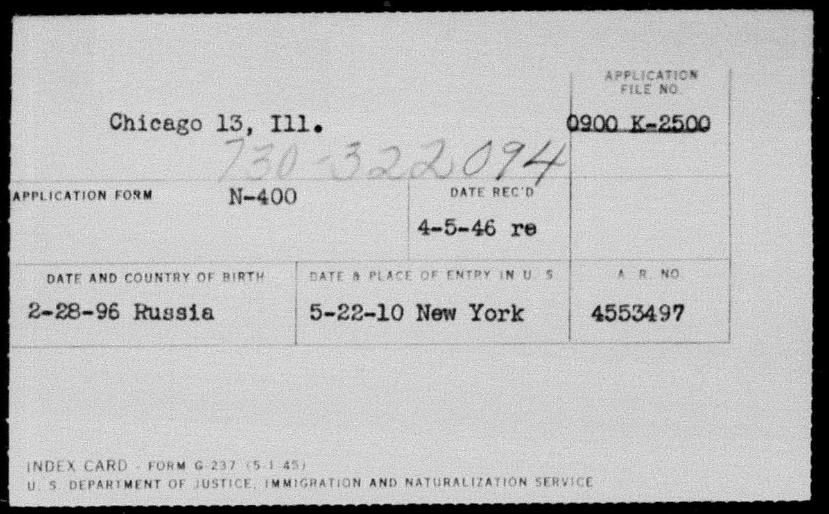
A quick email to NARA solved the mystery. The "730" prefix is the code for the United States District Court in Chicago.
If you visit NARA's page on naturalizations you'll find a link that will let you order copies of naturalization records online for $7.50 (includes postage).
If you need naturalization records from the Circuit Court Archives, you can submit a request by mail or I can retrieve them for you for a $10.00 fee.
Many of these records are also available on Family History Library films. Search the catalog to check for availability.
Sunday, June 10, 2012
Why Would the Recorder of Deeds have Death Records?
Back in November, I wrote about Sam Fink's Marriage and Death Indexes and I mentioned that some of the death index entries have volume and page numbers that refer to -- well, no one really seems to know.


Vital records are held by the Cook County Clerk's Office but Sam Fink made it clear that the volumes he was indexing were held by the Recorder of Deeds and, knowing a little bit about Sam Fink, I don't think he made a mistake. But why would the Recorder of Deeds have death records?
Here's one possible answer:
In a few weeks I'm going to make a trip to Van Buren County, Michigan with the hope of discovering the history of a particular property there. I was looking at the frequently-asked questions on their website today and this paragraph caught my eye:
Q: My spouse passed away and our property is in both our names, what do I do?
A: Bring in a certified copy of the death certificate and we will record it.
Is it possible that the same thing has been happening in Cook County from the late 1870s forward? Is it possible that the Recorder's Office entered death record information into large volumes to document the reasons for changes in ownership?
If that's the case, it's possible that the volumes Mr. Fink was indexing include records for deaths that happened both in and out of Cook County.
A few months ago I asked, casually, about the existence of the books that Mr. Fink was looking at but I didn't get very far and I didn't pursue it. I think I'll have to ask again.

And I also mentioned that there was a key to the years included in the index.

Vital records are held by the Cook County Clerk's Office but Sam Fink made it clear that the volumes he was indexing were held by the Recorder of Deeds and, knowing a little bit about Sam Fink, I don't think he made a mistake. But why would the Recorder of Deeds have death records?
Here's one possible answer:
In a few weeks I'm going to make a trip to Van Buren County, Michigan with the hope of discovering the history of a particular property there. I was looking at the frequently-asked questions on their website today and this paragraph caught my eye:
Q: My spouse passed away and our property is in both our names, what do I do?
A: Bring in a certified copy of the death certificate and we will record it.
Is it possible that the same thing has been happening in Cook County from the late 1870s forward? Is it possible that the Recorder's Office entered death record information into large volumes to document the reasons for changes in ownership?
If that's the case, it's possible that the volumes Mr. Fink was indexing include records for deaths that happened both in and out of Cook County.
A few months ago I asked, casually, about the existence of the books that Mr. Fink was looking at but I didn't get very far and I didn't pursue it. I think I'll have to ask again.
Friday, August 19, 2011
Cook County Circuit Court Archives: Criminal Case Index, 1873-1944
Recently a researcher asked if I could check indexes at the Circuit Court Archives for a crime that happened c. 1922. I'm always happy to learn something new and so I said I'd give it a try. I'm no expert on using this resource, but maybe a few quick notes about my experience will be helpful to someone else.
The microfiche index with the title "Counter Index Alpha Criminal Div" is kept in a thick black notebook on top of the filing cabinets. It covers 1873-1944, but some years are missing.
The entries for the earliest years are docket book pages. Information includes the name(s) of the defendant(s), the indictment number, the reason for indictment, a dollar amount that's probably bail, and brief dated notations that probably document various steps as the case proceeds. One of the cases had a December 1879 entry that seemed to read "Cont [or Cout] by Agt" and an August 1880 entry that said "Stricken off &c."
The later years have index pages with columns that read "Defendant," "Original Indictment #," "Charge," and "Amt of Bail." The pages are numbered and a date (month/year) is often stamped on.
The entries aren't alphabetical, but they're grouped by first letter of surname in chronological order and they're fairly easy to search. In my search, I looked at names and then checked the Charge column to take a closer look at the cases that might have been a match.
So what kinds of cases are recorded in these indexes? Skimming a single page I found entries that included
Rape, etc.
Burg, etc.
Larcy
Asslt intent to murder
Con games
What's the next step if you find a match in the index? The best answer can be found on the Archives list of holdings. If the records are still available, follow up. If not, perhaps the information gleaned from the index would lead to newspaper articles or other indirect sources of information.
For my search, I didn't find a match, but the files for the 1922 cases aren't available anyway. If I had been successful, though, the indictment records still exist.
So, now that I've had a first-look at the index fiche, I'd like to give it another try and I'm looking for a test case. If you are researching someone who might be mentioned in the Criminal Case Index, let me know. If you can narrow down the date--perhaps the crime is mentioned in the newspaper--email me. If I choose your project to work on, I'll check the index and follow up for free as long as you give me permission to blog about the search. (Disclaimer: If I came across a large file and you wanted me to copy more than what I needed for my post, I'd ask you to help with copy costs.)
The microfiche index with the title "Counter Index Alpha Criminal Div" is kept in a thick black notebook on top of the filing cabinets. It covers 1873-1944, but some years are missing.
The entries for the earliest years are docket book pages. Information includes the name(s) of the defendant(s), the indictment number, the reason for indictment, a dollar amount that's probably bail, and brief dated notations that probably document various steps as the case proceeds. One of the cases had a December 1879 entry that seemed to read "Cont [or Cout] by Agt" and an August 1880 entry that said "Stricken off &c."
The later years have index pages with columns that read "Defendant," "Original Indictment #," "Charge," and "Amt of Bail." The pages are numbered and a date (month/year) is often stamped on.
The entries aren't alphabetical, but they're grouped by first letter of surname in chronological order and they're fairly easy to search. In my search, I looked at names and then checked the Charge column to take a closer look at the cases that might have been a match.
So what kinds of cases are recorded in these indexes? Skimming a single page I found entries that included
Rape, etc.
Burg, etc.
Larcy
Asslt intent to murder
Con games
What's the next step if you find a match in the index? The best answer can be found on the Archives list of holdings. If the records are still available, follow up. If not, perhaps the information gleaned from the index would lead to newspaper articles or other indirect sources of information.
For my search, I didn't find a match, but the files for the 1922 cases aren't available anyway. If I had been successful, though, the indictment records still exist.
So, now that I've had a first-look at the index fiche, I'd like to give it another try and I'm looking for a test case. If you are researching someone who might be mentioned in the Criminal Case Index, let me know. If you can narrow down the date--perhaps the crime is mentioned in the newspaper--email me. If I choose your project to work on, I'll check the index and follow up for free as long as you give me permission to blog about the search. (Disclaimer: If I came across a large file and you wanted me to copy more than what I needed for my post, I'd ask you to help with copy costs.)
Saturday, August 14, 2010
Illinois Statewide Deaths Indexed a FamilySearch
FamilySearch's Record Search continues to grow and yesterday (August 13) a new series was added. The title is Illinois, Deaths and Stillbirths, 1916-1947 and the description reads "Name index of deaths and stillbirths in Illinois, 1916-1947. Includes records for Cook County and Chicago." The corresponding images don't seem to be online but the index provides a wealth of information (if listed on the record) including birth date and place, parent names and birth places, spouse name, burial date and place, and occupation.
If you want a copy of the actual record I will continue to offer access to the Chicago records (and some Cook) unless they go online for free and you can get the statewide death records from Molly Kennedy. (See "Lookups Available")
You can also order the films through any Family History Center. The cost is $5.50 + any notification fee a center might add and the reels usually arrive in about 2-4 weeks depending how often a center orders and whether or not a film is on backorder.
If you find a Chicago/Cook record, 1916-1922 listed in the statewide index, you should check FamilySearch's Illinois death certificates and stillbirths, including Chicago, 1946-1947 to see if the image is available there. Between 1916 and 1922 there should be some overlap in the two databases. Note the subtle differences between two entries for the same death.
If you want a copy of the actual record I will continue to offer access to the Chicago records (and some Cook) unless they go online for free and you can get the statewide death records from Molly Kennedy. (See "Lookups Available")
You can also order the films through any Family History Center. The cost is $5.50 + any notification fee a center might add and the reels usually arrive in about 2-4 weeks depending how often a center orders and whether or not a film is on backorder.
If you find a Chicago/Cook record, 1916-1922 listed in the statewide index, you should check FamilySearch's Illinois death certificates and stillbirths, including Chicago, 1946-1947 to see if the image is available there. Between 1916 and 1922 there should be some overlap in the two databases. Note the subtle differences between two entries for the same death.
| Collection: Illinois, Deaths and Stillbirths, 1916-1947 Note: Image not online Name: Thomas A. Bielby Titles and Terms (original): Death Date: 21 Aug 1916 Death Place: Chicago, Cook, Illinois Gender: Male Marital Status: Race or Color: Age: 42 Estimated Birth Year: 1874 Birth Date: Birthplace: Chicago, Ill Father: Thomas W. Bielby Father's Titles and Terms (original): Father's Birth Place: New York Mother: Catherine Reordan Mother's Titles and Terms (original): Mother's Birth Place: Ireland Occupation: switchman Residence: Chicago, Cook, Illinois Street Address: Spouse: Spouse's Titles and Terms (original): Spouse's Birthplace: Burial Date: 24 Aug 1916 Burial Place: Chicago, Cook, Illinois Cemetery: ... Informant: Additional Relatives: Digital Folder Number: 4152370 Image Number: 1603 Film Number: 1852282 Volume/Page/Certificate Number: 24078 | Collection: Illinois, Cook County Deaths, 1878-1922 Note: Image online Name: Thomas A. Bielby Titles & Terms: Death Date: 21 Aug 1916 Death Place: Chicago, Cook, Illinois Gender: Male Race (Original): W. Race (Standardized): White Death Age: 42y 6m Estimated Birth Year: 1874 Birth Date: Birthplace: Chgo., Ill. Marital Status: Spouse: Spouse's Titles & Terms: Father: Thomas W. Bielby Father's Titles & Terms: Father's Birthplace: New York Mother: Catherine Riordan Mother's Titles & Terms: Mother's Birthplace: Ireland Occupation: Switchman Street Address: 346 N. Lockwood Ave. Residence: Cemetery: Lyonsville Cem. Burial Place: Burial Date: 24 Aug 1916 Funeral Home: Informant: Additional Relatives: Film Number: 1276305 Digital Folder Number: 4004836 Image Number: 690 Reference Number: cn 24078 |
Saturday, May 08, 2010
Using Birth Registers to Search for Birth Certificates Not Coming Up on FamilySearch
I’ve had a number of researchers tell me, “I can’t find a birth certificate for that person on FamilySearch’s Record Search. It must not be online yet . . . “
I’m going to stick my neck out here. I suspect (but don’t know for certain) that the birth certificates available on FamilySearch now include all of the Chicago records that were available when the records were microfilmed.
My guess is that if a researcher can’t find a birth record online, it’s for one of two reasons:
1) The birth wasn’t reported so there’s no birth certificate to be found.
2) The name is misspelled in the index.
One of the best ways to check for both possibilities up through 1915 is to use the Chicago birth registers which are also online.
A little bit of background. It seems reasonable to me that the birth registers were created to log birth certificates that were returned to the county. The entries in all but the earliest books group names together by the first letter of the surname for each month. For example, all the “G” entries for April 1901 would be together, followed by all the “G” entries for May 1901, etc. The entries aren’t alphabetical. They’re in certificate number order which makes me think that the numbers were assigned as the records were recorded in the books.
So, because of the arrangement, it’s possible to use the registers as an alternate index if you know the month and year of birth or if you have a good deal of patience . . ..
Here’s how to do this at FamilySearch using an example of an “S” birth from January 1891:
1) Navigate to the search page for “Illinois, Cook County Birth Registers, 1871-1915.

2) Type a common name with the same letter of the name you’re looking for in the surname box and type the year of birth in the year ranges boxes. In this case, I'm looking for an "S" birth, so I’ll use “Smith." For surnames beginning with other letters, you may have to try a few different names to be able to find a register in the ballpark of the month/year/name you're looking for.
3) Browse to find a birth from the same month you’re looking for. In this case, “Henry Smith” born January 1891 will work.
![]()
4) Click on the name, then click on the small thumbnail in the upper right-hand corner to view the register image.
![]()
5) Use the arrow buttons to navigate back to the beginning of the “S” section for January 1891. The month is usually on top of the left-hand page; the year is on top of the right-hand page. Each page has fifty entries and in my experience, even common letters of the alphabet have just a few pages to check.
6) View each register page looking for a match. I often look at the surname, the birth date, the mother’s name, and/or the father’s name.
A few tips on using the birth registers:
1) The catalog entries in the Family History Library Catalog can help you figure out the arrangement of the register entries. For example, in this case, the December 1890 “S” births came just before the January 1891 S” births. For some years, they might be in different books.
2) The register entries cross two pages.
3) For some of the later years, you might find stillbirths or infants who died soon after birth listed at the end of each section.
4) If you find a matching register entry, there should be a matching birth certificate and if you’re using film, you can use the register number to find the certificate. Most certificate numbers have five digits but you might see just two by the names on the page. Look at the very top line to find the other digits.
5) If you find a matching entry and want to locate the corresponding record on FamilySearch but haven't been able to pull it up there before searching the name, try searching for other names on the register page. If you can find a close certificate, you should be able to easily navigate to the right one.
If the birth certificates were assigned numbers when they were entered in to the registers then I think it’s unlikely that many were missed. If a certificate didn’t have a number, it couldn’t be filed away. And as long as a birth was recorded under the proper first letter, then it should be possible to pick out a match in the register even if the name is badly misspelled. Based on these two assumptions, if you don’t find a matching entry in the birth register, then it’s very likely there is no birth certificate to be found on FamilySearch.
If that turns out to be the case, there are a number of things you can do. Here are some ideas:
1) Look for a delayed birth certificate
2) Look for a baptismal record
3) Look for a Social Security application
4) Check for a passport application
5) Check for a school record
I’m going to stick my neck out here. I suspect (but don’t know for certain) that the birth certificates available on FamilySearch now include all of the Chicago records that were available when the records were microfilmed.
My guess is that if a researcher can’t find a birth record online, it’s for one of two reasons:
1) The birth wasn’t reported so there’s no birth certificate to be found.
2) The name is misspelled in the index.
One of the best ways to check for both possibilities up through 1915 is to use the Chicago birth registers which are also online.
A little bit of background. It seems reasonable to me that the birth registers were created to log birth certificates that were returned to the county. The entries in all but the earliest books group names together by the first letter of the surname for each month. For example, all the “G” entries for April 1901 would be together, followed by all the “G” entries for May 1901, etc. The entries aren’t alphabetical. They’re in certificate number order which makes me think that the numbers were assigned as the records were recorded in the books.
So, because of the arrangement, it’s possible to use the registers as an alternate index if you know the month and year of birth or if you have a good deal of patience . . .
Here’s how to do this at FamilySearch using an example of an “S” birth from January 1891:
1) Navigate to the search page for “Illinois, Cook County Birth Registers, 1871-1915.

2) Type a common name with the same letter of the name you’re looking for in the surname box and type the year of birth in the year ranges boxes. In this case, I'm looking for an "S" birth, so I’ll use “Smith." For surnames beginning with other letters, you may have to try a few different names to be able to find a register in the ballpark of the month/year/name you're looking for.
3) Browse to find a birth from the same month you’re looking for. In this case, “Henry Smith” born January 1891 will work.

4) Click on the name, then click on the small thumbnail in the upper right-hand corner to view the register image.

5) Use the arrow buttons to navigate back to the beginning of the “S” section for January 1891. The month is usually on top of the left-hand page; the year is on top of the right-hand page. Each page has fifty entries and in my experience, even common letters of the alphabet have just a few pages to check.
6) View each register page looking for a match. I often look at the surname, the birth date, the mother’s name, and/or the father’s name.
A few tips on using the birth registers:
1) The catalog entries in the Family History Library Catalog can help you figure out the arrangement of the register entries. For example, in this case, the December 1890 “S” births came just before the January 1891 S” births. For some years, they might be in different books.
2) The register entries cross two pages.
3) For some of the later years, you might find stillbirths or infants who died soon after birth listed at the end of each section.
4) If you find a matching register entry, there should be a matching birth certificate and if you’re using film, you can use the register number to find the certificate. Most certificate numbers have five digits but you might see just two by the names on the page. Look at the very top line to find the other digits.
5) If you find a matching entry and want to locate the corresponding record on FamilySearch but haven't been able to pull it up there before searching the name, try searching for other names on the register page. If you can find a close certificate, you should be able to easily navigate to the right one.
If the birth certificates were assigned numbers when they were entered in to the registers then I think it’s unlikely that many were missed. If a certificate didn’t have a number, it couldn’t be filed away. And as long as a birth was recorded under the proper first letter, then it should be possible to pick out a match in the register even if the name is badly misspelled. Based on these two assumptions, if you don’t find a matching entry in the birth register, then it’s very likely there is no birth certificate to be found on FamilySearch.
If that turns out to be the case, there are a number of things you can do. Here are some ideas:
1) Look for a delayed birth certificate
2) Look for a baptismal record
3) Look for a Social Security application
4) Check for a passport application
5) Check for a school record
Tuesday, October 27, 2009
Adoption Research: Using the Chicago Daily Law Bulletin to Find Birth Names
I have learned a lot from conversations with other researchers and recently a patron at the Wilmette Family History Center told me how she found a birth name for her father who was adopted in 1927. The resource she used was new to me and I was intrigued. I thought others might benefit from her experience and so I asked her to write a guest post for my blog. She graciously agreed and you’ll find her contribution below.
Update (2 Dec 2018): There is one Genlighten.com provider who can help find adoption information in Cook County:
Illinois Adoption Lookup for Cook County, Chicago, 1934 - 1963 from julic
My sincere thanks to Barbara, the author of this guest post.
ADOPTIONS IN COOK COUNTY
Unknown to most adopted people and their families, there is a record that can be easily accessed that will give the birth name of the child given up for adoption in the majority of cases: the Chicago Daily Law Bulletin (CDLB). Adoptions are legalized through the county level of the court system and the petitions to adopt are posted in the CDLB and list the adoptive parents and the infant or child they wish to adopt.
 The Rinn Law Library of DePaul University on 25 E. Jackson in Chicago has all of the CDLBs on microfilm and, most importantly, THESE RECORDS ARE PART OF THE PUBLIC DOMAIN AND CAN BE ACCESSED BY ANYONE! The library is located on the 5th floor and the microfilms are kept behind the check in desk.
The CDLB is very organized and the section where the petitions are listed is usually on page 3 or 4 under “New Cases” for County Court, which always falls after the Superior Court listings and before the Probate Court ones. Since the CDLB is published daily there are only 6 to 10 pages at most so one can search through a lot of records relatively quickly. My own successful search for the birth name of my father, who was adopted as infant in 1927, took a scant few hours and some of that time was wasted in looking through the Legal Notices sections for Adoption Notices. The only time adoptive parents post an Adoption Notice is when the biological father or family of the child has not consented to the adoption, or the infant’s identity was truly unknown (i.e., a foundling).
The other mistake I made was in looking in the CDLB issues that were published less than 6 months after the birth of my father -- the child has to have been living in the adoptive household for a minimum of 6 months before they can petition to adopt. I found his petition was filed almost exactly 7 months after his birth so it is a strong possibility that he may have been 1 month old at the time of his surrender to my grandparents.
Once you have the birth name you can look for the birth mother in other documents, e.g. census data, birth indexes (for the mother’s name), etc.
For those whose adoptions took place in other counties or states I recommend contacting Melisha Mitchell, founder of the White Oak Foundation (www.whiteoakfoundation.org). Melisha is a great resource and passionate advocate for adoptees and their families. It was she who told me where to find these records and of the 6 month waiting limit. Her website is chock-full of information and has many links to other resources as well.
Update (2 Dec 2018): There is one Genlighten.com provider who can help find adoption information in Cook County:
Illinois Adoption Lookup for Cook County, Chicago, 1934 - 1963 from julic
My sincere thanks to Barbara, the author of this guest post.
ADOPTIONS IN COOK COUNTY
Unknown to most adopted people and their families, there is a record that can be easily accessed that will give the birth name of the child given up for adoption in the majority of cases: the Chicago Daily Law Bulletin (CDLB). Adoptions are legalized through the county level of the court system and the petitions to adopt are posted in the CDLB and list the adoptive parents and the infant or child they wish to adopt.
 The Rinn Law Library of DePaul University on 25 E. Jackson in Chicago has all of the CDLBs on microfilm and, most importantly, THESE RECORDS ARE PART OF THE PUBLIC DOMAIN AND CAN BE ACCESSED BY ANYONE! The library is located on the 5th floor and the microfilms are kept behind the check in desk.
The CDLB is very organized and the section where the petitions are listed is usually on page 3 or 4 under “New Cases” for County Court, which always falls after the Superior Court listings and before the Probate Court ones. Since the CDLB is published daily there are only 6 to 10 pages at most so one can search through a lot of records relatively quickly. My own successful search for the birth name of my father, who was adopted as infant in 1927, took a scant few hours and some of that time was wasted in looking through the Legal Notices sections for Adoption Notices. The only time adoptive parents post an Adoption Notice is when the biological father or family of the child has not consented to the adoption, or the infant’s identity was truly unknown (i.e., a foundling).
The other mistake I made was in looking in the CDLB issues that were published less than 6 months after the birth of my father -- the child has to have been living in the adoptive household for a minimum of 6 months before they can petition to adopt. I found his petition was filed almost exactly 7 months after his birth so it is a strong possibility that he may have been 1 month old at the time of his surrender to my grandparents.
Once you have the birth name you can look for the birth mother in other documents, e.g. census data, birth indexes (for the mother’s name), etc.
For those whose adoptions took place in other counties or states I recommend contacting Melisha Mitchell, founder of the White Oak Foundation (www.whiteoakfoundation.org). Melisha is a great resource and passionate advocate for adoptees and their families. It was she who told me where to find these records and of the 6 month waiting limit. Her website is chock-full of information and has many links to other resources as well.
Saturday, March 12, 2005
Stillbirth Entries in Chicago Death Index
The Chicago Death Index (aka Burial Permit Index) lists some entries for stillbirths (SB) before 1916 but where are the certificates?
Subscribe to:
Posts (Atom)
Using the Family History Library Record Lookup Service
Have you heard about the Family History Library Record Lookup Service? It's a very convenient way to obtain digital copies of Chicago vi...
-
 Recently, I made an interesting-to-me discovery that I thought would be worth sharing. Below are two FamilySearch death index entries fo...
 -
 When I look at birth certificates, I focus on names and dates and places--information I can add to a family tree. When I look at hospital ...
 -
 One of the challenges in doing research in Chicago and Cook County is that many early births weren’t reported to the county clerk’s office. ...