I received an email from one of my clients and I think she’s come across a wonderful example of how powerful the Record Search pilot site is. With her permission, I will post her note here in a slightly edited form.
Thank you, Margie!
Cynthia
________________________________________________________________________
When the Chicago birth certificates became available [at www.familysearch.org] I pulled up everyone I could think of. I was looking for two sisters, Mabel and Joan Hayes.
I found Joan.
Baby not yet named
Second baby, two living
Father, Joseph Hayes, born in Pontiac Illinois, age 37, laborer
Mother Hannah Austgen Hayes, born in St. John, Indiana, age 31
I could not find Mabel. When I search for the name Austgen, I came up with
Mary *BROWN*
First baby, one living
Born December 29, 1910
Father, Joseph BROWN, born in Pontiac, Illinois, age 37, laborer
Mother, Hannah AUSTIN BROWN, born in Dyer, Illinois, age 29
Dyer is in Indiana, not Illinois, and is right next to St. John. The birth places of the parents matched so well!
This looked suspiciously like Mabel's birth certificate. Mabel's middle name could be Mary, her middle initial is M. I ordered the death certificates, and … guess what Mabel's birth date is: December 29, 1910! And on the death certificate, her father is born in Pontiac, her mother in St. John.
Can you believe it! It has the … wrong family name! I noticed it wasn't filed for more than a month after the birth. It’s like the doctor said, “What was that name? Something common? Oh, yeah, Brown.”
Funny thing, I NEVER would have thought of looking for the Hayes family under Brown!
Monday, February 23, 2009

Friday, February 20, 2009
Chicago Births at Record Search: When the Index Doesn't Match the Record

My husband pointed me to a blog called "TransylvanianDutch" which mentions the Cook County birth records online at FamilySearch Record Search. The author spotlights a birth record that's indexed as "Clifford Paul Cruvant" but clearly says "Edward Cruvant" and asks "What was the indexer looking at?" He goes on to say, "I want to know what that document is, what other information I might expect to find on it, and where I can get a copy of it."
I think I can be of help here.
The indexer must have been looking at the Certificate of Correction which was filmed just after the original birth certificate. This correction form doesn't seem to be included with the linked records on the FamilySearch Record Search site but it is available on Family History Library Film 1288077. The Certificate of Correction is numbered the same as the birth record and it includes the child's name as it appears on the certificate, the corrected name, the birth date and address, and the name of the person who submitted the correction. I suspect it also includes the date the correction was made, but the bottom part of this particular record isn't readable.
In a similar instance, one of my clients found an index entry for a birth register page that included a father's name, but that information was covered by a piece of paper attached to the register page on the linked scan. (The paper was probably a birth certificate form or a correction.) On the film, though, the next image is of the same page with the paper lifted to show the information underneath.
Saturday, January 24, 2009
The Chicago Fire: Was Your Ancestor Insured?
 My husband's ancestor, James Ayer Smith, arrived in Chicago in the spring of 1835 with plans to open a hat and cap store, and in August of that year, his father sent him a letter with some very detailed advice on how to succeed.
 In closing, he wrote, "There has been a heavy fire at Cleveland & I hope you will not fail to have insurance made on your stock immediately to the full amount Your affectionate Father Chas. Smith." James appears to have taken that advice.
When he lost business property in a fire in 1857, he received a $3000 settlement, with payments shared by six insurance companies. And in 1871, when The Chicago Fire hit, he was once again well insured. For example, James A. Smith & Co. had a policy from Washington Insurance Company purchased in August, 1871 in force through November of the same year "against loss or damage by fire ... on Furs manufactured or unmanufactured, also on Wearing Apparel manufactured in whole or in part of Furs or manufactured entirely of any other materials, Fur and Buffalo Robes and Lap Blankets left with them for safe keeping and for the deliver of which to the owners, they have made themselves responsible, loss or no loss, contained in the fourth story of the four story brick building with stone front known as Nos 34 and 36 Washington Street Chicago Illn." The policy was sold by Miller & Drew on La Salle in Chicago and the $10.00 premium provided $2500.00 worth of coverage.
 Based on a list of policies held, goods covered, and settlement amounts, James appears to have had at least twenty-eight policies in effect at the time of the fire. But what about your ancestor? Was he or she insured?
Because extensive damage meant an unusually high number of claims, many insurance companies filed for bankruptcy and court documents related to these proceedings include lists of creditors--people with claims.
For example, creditors of The Republic Insurance Company of Chicago, Illinois listed in papers published by the District Court included the following:
RESIDING IN CHICAGO, ILL.
John Cronin $250
Charles E. Crandall $500
C H McCormick $27500 (one of many entries for him)
Mrs. K Fishback $200
Patrick Murphy $381.06
Methodist Book Concern $2500
Gilbert Hubbard Co. $453.22
And the list goes on--three pages, four columns each, with tiny type. And that's just one insurance company. There are similar documents for many other companies included in the James A. Smith papers.
Unfortunately, the names on the lists aren't alphabetical. It would take some time to search for a particular name, and if the name was common, "Patrick Murphy," for example, it would be hard to determine whether or not the person listed was actually an ancestor. But if you are researching a unique name, it might be worth taking a look.
 Lists of creditors are available from documents included in the James A. Smith papers, held by the Minnesota Historical Society, but they may also be available from the courts which handled the bankruptcy proceedings. Two of those mentioned in the James A. Smith documents include the District Court, Northern District of Illinois, and the District Court, Northern District of New York.
[With the exception of the letter from Charles Smith to James A. Smith which is held by the Chicago Historical Society, all other documents mentioned and/or shown in this post are from the James A. Smith Papers held by the Minnesota Historical Society.]
Tuesday, January 13, 2009
Gleanings from "Legal Friend of the People"
In January, 1911, the Chicago Daily Tribune began publishing a column called “Legal Friend of the People.” Readers wrote in to ask questions about legal matters and topics ranged from what to do about a neighbor’s bothersome ducks to marriage, probate, and citizenship. For genealogists, this column is a rich source of information about the laws of the times.
Below are some examples of the kinds of things I've learned from the Legal Friend. (I have access to the Chicago Tribune Historical Archives online--the source of the columns mentioned below--using my Chicago Public Library card.)
4 Mar 1912, p. 8: The legal age of a woman is 18; legal age of a man is 21.
11 Mar 1912, p. 8: Illinois law states that a divorced person must wait one year before remarrying; in questionable cases, couple should be remarried
11 Mar 1912, p. 8: Common law wife has same rights as any other wife, but definition of common law wife is strict; best to have legal marriage performed
18 Mar 1912, p. 10: Indiana marriage license is not good in Illinois
28 Mar 1912, p. 10: Nevada laws permit remarriage within months of a divorce; marriage there under those circumstances would be considered legal in all other states.
1 Apr 1912, p. 10: Nieces and nephews would inherit if unmarried uncle dies with no living parents or siblings
8 Apr 1912: Legal name change can be done through Circuit Court for about $15; Slight change in spelling wouldn’t require legal proceedings
12 Apr 1912: Aliens who have served in the United States military can receive citizenship with petition (no previous declaration of intent) and have only to prove a one-year residence
15 Apr 1912, p. 10: Wife desertion punishable by a fine or imprisonment; husband cannot be brought back from another state
29 Apr 1912, p. 10: If a man marries under an assumed name, he should obtain another license in his real name and be married again
6 May 1912, p. 4: Statute prohibiting marriage in Illinois during the first year after divorce went into effect 1 Jul 1905
3 Jun 1912, p. 6: Seventeen year old girl married without parental consent, lived with husband four months then went home; he cannot support her; marriage can be annulled
17 Jun 1912, p. 6: Statue prohibiting common law marriage went into effect July 1 … [year is difficult to read; probably 1900 or 1909]
19 Jun 1912, p. 6: If a spouse leaves for more than two years, it is grounds for divorce
5 Jul 1912, p. 6: If a father gains citizenship before his son turns 21, the son automatically becomes a citizen; if the son reaches 21 before the father gains citizenship, the son can file his own petition
8 Jul 1912, p. 4: Illinois divorce cases usually called within a couple of months of filing
27 Nov 1916, p. 8: Minister visiting from another state can marry an individual who has obtained a Cook County marriage license
22 Oct 1917: Man married in Florida, wife left him in England, and he is back in the United States; he would have to get a divorce before remarrying here
17 Dec 1917: Law making it illegal for divorced persons to marry until a year had passed went into effect 1 Jul 1905
24 Dec 1917: Woman divorces in Illinois, goes to Michigan to marry an Illinois resident and returns; “Evasion Act” might make marriage invalid
31 Dec 1917: A marriage between persons who used assumed names to get license is legal, but the parties are subject to punishment; Crown Point marriages are not announced routinely in Chicago in a public way
30 March 1918: No “statutory limit” on when a marriage license has to be used
20 May 1918, p. 6: A marriage license from Indiana can’t be used in Illinois
3 Jun 1918, p. 8: Marriage license generally issued by County Clerk; offices not open on Sundays
Below are some examples of the kinds of things I've learned from the Legal Friend. (I have access to the Chicago Tribune Historical Archives online--the source of the columns mentioned below--using my Chicago Public Library card.)
4 Mar 1912, p. 8: The legal age of a woman is 18; legal age of a man is 21.
11 Mar 1912, p. 8: Illinois law states that a divorced person must wait one year before remarrying; in questionable cases, couple should be remarried
11 Mar 1912, p. 8: Common law wife has same rights as any other wife, but definition of common law wife is strict; best to have legal marriage performed
18 Mar 1912, p. 10: Indiana marriage license is not good in Illinois
28 Mar 1912, p. 10: Nevada laws permit remarriage within months of a divorce; marriage there under those circumstances would be considered legal in all other states.
1 Apr 1912, p. 10: Nieces and nephews would inherit if unmarried uncle dies with no living parents or siblings
8 Apr 1912: Legal name change can be done through Circuit Court for about $15; Slight change in spelling wouldn’t require legal proceedings
12 Apr 1912: Aliens who have served in the United States military can receive citizenship with petition (no previous declaration of intent) and have only to prove a one-year residence
15 Apr 1912, p. 10: Wife desertion punishable by a fine or imprisonment; husband cannot be brought back from another state
29 Apr 1912, p. 10: If a man marries under an assumed name, he should obtain another license in his real name and be married again
6 May 1912, p. 4: Statute prohibiting marriage in Illinois during the first year after divorce went into effect 1 Jul 1905
3 Jun 1912, p. 6: Seventeen year old girl married without parental consent, lived with husband four months then went home; he cannot support her; marriage can be annulled
17 Jun 1912, p. 6: Statue prohibiting common law marriage went into effect July 1 … [year is difficult to read; probably 1900 or 1909]
19 Jun 1912, p. 6: If a spouse leaves for more than two years, it is grounds for divorce
5 Jul 1912, p. 6: If a father gains citizenship before his son turns 21, the son automatically becomes a citizen; if the son reaches 21 before the father gains citizenship, the son can file his own petition
8 Jul 1912, p. 4: Illinois divorce cases usually called within a couple of months of filing
27 Nov 1916, p. 8: Minister visiting from another state can marry an individual who has obtained a Cook County marriage license
22 Oct 1917: Man married in Florida, wife left him in England, and he is back in the United States; he would have to get a divorce before remarrying here
17 Dec 1917: Law making it illegal for divorced persons to marry until a year had passed went into effect 1 Jul 1905
24 Dec 1917: Woman divorces in Illinois, goes to Michigan to marry an Illinois resident and returns; “Evasion Act” might make marriage invalid
31 Dec 1917: A marriage between persons who used assumed names to get license is legal, but the parties are subject to punishment; Crown Point marriages are not announced routinely in Chicago in a public way
30 March 1918: No “statutory limit” on when a marriage license has to be used
20 May 1918, p. 6: A marriage license from Indiana can’t be used in Illinois
3 Jun 1918, p. 8: Marriage license generally issued by County Clerk; offices not open on Sundays
Sunday, January 11, 2009
The Problem with "Only"
I'm not sure I'm the best one to point this out. After all, I earn extra income by looking up Chicago birth, marriage, and death records for researchers for a small fee. But, on the other hand, one of my goals is to educate researchers on which Chicago and Cook County records can be found where, and I think this falls under that umbrella. So, here goes . . .
I was just searching Ancestry.com, hoping to stumble on some information about a person I'm researching, and I ended up in the Cook County Death Index, 1908-1988. It's a handy resource, but I think one small tweak needs to be made to the results page.
 When I rolled over the "Purchase from Cook County" link, the pop-up read "Indexes have been made available here at Ancestry, however, images and original certificates are only available through the Cook County Clerk's office" and the word "only" isn't quite right. Chicago and Cook County death records up through 1947 are available both in Springfield and on microfilm that can be viewed at or borrowed from the Family History Library in Salt Lake. And, in the Chicago area, they're available at the Wilmette Family History Center.
It's likely that the word "only" is there because it's much easier to phrase it that way than it is to try to explain that some records are available from a number of repositories while others are only available from the clerk's office, but it would be better to just leave the "only" out. Most people would just click through and purchase the records from www.cookcountygenealogy.com anyway.
I applaud Ancestry and the Cook County Clerk's Office, by the way, for teaming up to make this index and the corresponding records easily available to researchers. I really do. Sometimes people ask me, "Can you get records after 1947? and sometimes they mutter, just a tiny bit, when they find out that I can't, and that they will have to pay $15 for whatever they need. My reply? It costs money to preserve valuable records and to build applications like the new Cook County vital records website and $15 is money well spent if you need a record to keep your research moving forward.
I was just searching Ancestry.com, hoping to stumble on some information about a person I'm researching, and I ended up in the Cook County Death Index, 1908-1988. It's a handy resource, but I think one small tweak needs to be made to the results page.
 When I rolled over the "Purchase from Cook County" link, the pop-up read "Indexes have been made available here at Ancestry, however, images and original certificates are only available through the Cook County Clerk's office" and the word "only" isn't quite right. Chicago and Cook County death records up through 1947 are available both in Springfield and on microfilm that can be viewed at or borrowed from the Family History Library in Salt Lake. And, in the Chicago area, they're available at the Wilmette Family History Center.
It's likely that the word "only" is there because it's much easier to phrase it that way than it is to try to explain that some records are available from a number of repositories while others are only available from the clerk's office, but it would be better to just leave the "only" out. Most people would just click through and purchase the records from www.cookcountygenealogy.com anyway.
I applaud Ancestry and the Cook County Clerk's Office, by the way, for teaming up to make this index and the corresponding records easily available to researchers. I really do. Sometimes people ask me, "Can you get records after 1947? and sometimes they mutter, just a tiny bit, when they find out that I can't, and that they will have to pay $15 for whatever they need. My reply? It costs money to preserve valuable records and to build applications like the new Cook County vital records website and $15 is money well spent if you need a record to keep your research moving forward.
Monday, December 29, 2008
Searching Chicago City Directories at Footnote.com
Chicago city directories, seventy-three volumes covering 1843 to 1923, are available on Footnote.com and because they are fully searchable, they offer plenty of research possibilities to those who learn how to easily access them. Here's my approach:
1) Log into Footnote.com and select BROWSE, NEWS AND TOWN RECORDS, CITY DIRECTORIES, ILLINOIS, CITY DIRECTORIES--CHICAGO. If you want to search every year available, scroll down and type in your key word(s) in the "Search within: News and Town Records » City Directories » Illinois » City Directories - Chicago IL" box. If you want to search a specific year, read on.
2) Click on the year you want to search. Then, type the surname you're looking for into the "Search within" box at the bottom of the screen. Scroll through the results until you find one that is close to the name you're looking for. "1843 » Rhines, Henry (p. 23)" will bring you to a page that begins with Rhines, Henry. If you were looking for "Roth" or even "Smith," you could navigate to the Rhines page and then use the small thumbnail navigation bar at the bottom of the screen to quickly locate the page you really needed. The rollover feature makes that easy to do.
But don't just limit your searches to names. Over the Christmas holiday, I had the pleasure of starting a small curiosity project of my own--trying to find out more about a Boston violin maker named John S. Allen--and searching known business and home addresses allowed me to find others who were working and/or living at the same addresses--though not necessarily working in the same business or living in the same apartment. I also tried searching "violin maker" and "violinmaker" (they brought up different entries) to see who else might have been working in the city in the same year.
1) Log into Footnote.com and select BROWSE, NEWS AND TOWN RECORDS, CITY DIRECTORIES, ILLINOIS, CITY DIRECTORIES--CHICAGO. If you want to search every year available, scroll down and type in your key word(s) in the "Search within: News and Town Records » City Directories » Illinois » City Directories - Chicago IL" box. If you want to search a specific year, read on.
2) Click on the year you want to search. Then, type the surname you're looking for into the "Search within" box at the bottom of the screen. Scroll through the results until you find one that is close to the name you're looking for. "1843 » Rhines, Henry (p. 23)" will bring you to a page that begins with Rhines, Henry. If you were looking for "Roth" or even "Smith," you could navigate to the Rhines page and then use the small thumbnail navigation bar at the bottom of the screen to quickly locate the page you really needed. The rollover feature makes that easy to do.
But don't just limit your searches to names. Over the Christmas holiday, I had the pleasure of starting a small curiosity project of my own--trying to find out more about a Boston violin maker named John S. Allen--and searching known business and home addresses allowed me to find others who were working and/or living at the same addresses--though not necessarily working in the same business or living in the same apartment. I also tried searching "violin maker" and "violinmaker" (they brought up different entries) to see who else might have been working in the city in the same year.
Saturday, July 26, 2008
Two Sets of Death Certificates--1908-1915
Between 1908 and 1915, there are two sets of Chicago death certificates listed in the Family History Library Catalog. One group (the largest) is organized by "certificate number"--the number you find in the online index. The other group is organized by "register number"--the number you find in the Chicago Death Index, 1871-1933, a microfilm index.
So, what's the difference between the two groups? In some cases, but not necessarily all, the record found in the register number group appears to be a copy of the original death certificate. The writing is neat and in one hand.
However, I don't think all of the records in the register number group are copies. I was unable to find a death record on a certificate number film today--it seemed to be missing--and when I located the corresponding record on the register number film, the record looked to be original.
So, what's the difference between the two groups? In some cases, but not necessarily all, the record found in the register number group appears to be a copy of the original death certificate. The writing is neat and in one hand.
However, I don't think all of the records in the register number group are copies. I was unable to find a death record on a certificate number film today--it seemed to be missing--and when I located the corresponding record on the register number film, the record looked to be original.
Subscribe to:
Posts (Atom)
Using the Family History Library Record Lookup Service
Have you heard about the Family History Library Record Lookup Service? It's a very convenient way to obtain digital copies of Chicago vi...
-
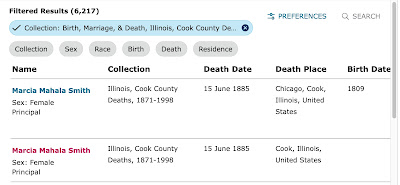
 Recently, I made an interesting-to-me discovery that I thought would be worth sharing. Below are two FamilySearch death index entries fo...
 -
 When I look at birth certificates, I focus on names and dates and places--information I can add to a family tree. When I look at hospital ...
 -
 One of the challenges in doing research in Chicago and Cook County is that many early births weren’t reported to the county clerk’s office. ...