Sunday, January 27, 2013

Some Chicago Images No Longer Available on FamilySearch

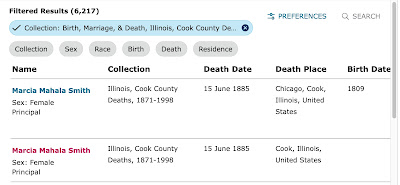
This morning I received an email from a fellow researcher mentioning that the images for Illinois, Cook County Deaths, 1878-1922 are no longer available online at FamilySearch. Unfortunately, it's true. The same is true for the Cook County birth register, birth certificate, and marriage license collections. On a positive note, the indexes remain. Two steps forward + one step back still = one step forward for Chicago researchers.

If you visit the FamilySearch Wiki page Illinois, Cook County Death Records and scroll down to the "Image Visibility" section, it explains that a new contract has been negotiated with Cook County and that the records were removed as part of that agreement. The article continues on to explain that "FamilySearch will receive an additional 4.7 million records for FamilySearch patrons." I don't know what that means, but I hope it's good news.

If you need access to the images that were removed, the Wiki page offers three suggestions including submitting a request to FamilySearch's Photoduplication Services, a way to get limited number of records for free. Also, for those of you in the Chicago area, most all of the films for the early records are available at the Wilmette Family History Center but check their holdings before you make the trip.

I can't fill in the gap by offering free lookups, but I will add these records back to the list of documents that I can retrieve through my chicagogenealogy store on Genlighten.com. I'm wondering about the possibility of offering to take quick iPhone camera photos of the records for a budget-friendly price. They'd be quite large and readable, but they wouldn't look like images scanned directly from film or like the images that I get when I print and scan a paper copy. What do you think? Would that be of interest?

Thursday, September 13, 2012

Chicago Naturalization Searches: What the "730" Means

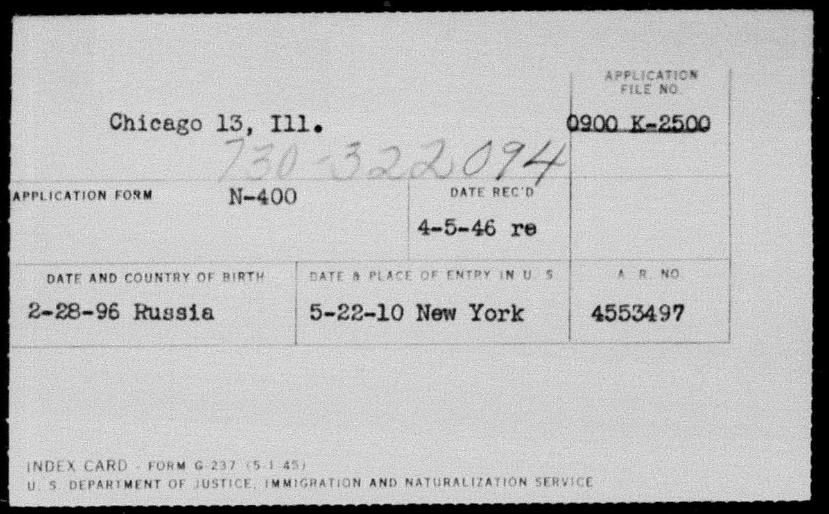
If you search the Illinois, Northern District Naturalization Index, 1840-1950 at FamilySearch, you'll probably come up with a card like this one:


If the court is listed as Circuit, County, Criminal, or Superior then the record is held by the Cook County Circuit Court Archives. If the court is listed as District, then NARA Great Lakes has the record. But, what if no court is listed?

Recently I had a client send me the two cards below and I wasn't sure how to follow up because no courts were given. (I removed the names for posting.)


A quick email to NARA solved the mystery. The "730" prefix is the code for the United States District Court in Chicago.

If you visit NARA's page on naturalizations you'll find a link that will let you order copies of naturalization records online for $7.50 (includes postage).

If you need naturalization records from the Circuit Court Archives, you can submit a request by mail or I can retrieve them for you for a $10.00 fee.

Many of these records are also available on Family History Library films. Search the catalog to check for availability.


Sunday, August 05, 2012

Family History Expo Day 2: New Research Ideas

Okay. I'll be honest. The Springfield Family History Expo memory that will stay with me the longest--maybe forever--was my encounter with the warm pecan buns that were available as the final stop on the breakfast buffet that I splurged on the morning of the second day. They were delicious beyond words and I ended up eating four of them. (They were small. Really.)

After breakfast, I headed to the patio on the 14th floor, played a few fiddle tunes to relax and start the day off right, and then I headed to class.

First up, "Tracing American Ancestors Who Lived in Cities," a double-session workshop taught by Arlene H. Eakle, Ph.D. She shared many wise insights but here are three of my favorites:
  • People move within cities. First they live on the top floor, then they moved to the basement. From there, they move to the first floor and then (I'm pretty sure I have this right) they move on to better neighborhoods. How many of us have followed families through address after address in the Chicago city directories? That might be a reason.
  • Cities are big. Lots of people, right? And imagine how many births and deaths there would be to record in a single day. Imagine what it would be like for a single clerk handle that. Cities might  have kept multiple registers for events that happened during the same time period. Just because a name doesn't appear in one record doesn't mean that the event didn't happen in the area. Look for other records. This is relevant to Chicago/Cook research. For example, you WILL NOT find a "Chicago" birth recorded in a "Cook County" birth register even though Chicago is in Cook County. Why? Because Chicago births were recorded in "Chicago" birth registers. 
  • Some occupations are tied to a geographic area. Makes sense, right? If you are a coal miner, you live where there's coal. If you are a commercial weaver then you live where there's a mill. If your immigrant ancestor had a trade, you might be able to use that occupation along with other clues to figure out where the family lived previously. 
As a side note, Arlene uses an overhead projector and carries her transparencies around in notebooks. It's refreshingly old-school and it gives her lectures breathing room and flexibility. I liked it.

After a short lunch break, I sat in on James L. Tanner's "A Review of Major Genealogical Libraries and Repositories." The take-away from that? Two websites--archive.org and loc.gov. I was aware of both, but hadn't really explored either in much depth. But, what's a lazy Sunday afternoon for if it isn't for that?

archive.org
Census records to 1930 are there, free, in an easy-to-browse format. And, of course, there are thousands of scanned books of interest to family history researchers.

I'm fascinated by the media section, though. t took a bit of digging through some modern uploads, but I stumbled on a number of Chicago-related movies. If you missed Chicago's 1933 Century of Progress Exposition, it's not too late to take a tour (no sound). Or maybe you just discovered that your ancestor was a sign monkey. A what? Check out this informative movie about Chicago's Chevrolet sign. (I wonder what happened to it? Anyone know?) And where could a family turn for a small depression-era loan? Check out Financing the American Family

loc.gov
You'll want to explore this site in some detail, but this morning I followed up on the class suggestion to look at the Historic Newspaper section.  I typed in "valentine smith" with "chicago" (Valentine, the subject of one of my long-term research projects, worked tirelessly to promote and preserve Chicago's history during the early 1900s) and got two results.


The one from Maysville, Kentucky caught my eye--I've visited there for research--and so I clicked through.


I have long sensed that Valentine was a "society woman" but it was nice to see that someone else viewed her that way, too. I knew that she was involved in Chicago's centennial celebration, but I didn't realize, specifically, that she'd written a poem for it and I had no idea that writing had been a passion for her since childhood. If James Whitcomb Riley was an "admirer," how did he become acquainted with her work? Did their lives cross paths? Did she publish any of her writing? And why would a Maysville paper mention Valentine and James? Research-wise, I'm off and running again.

My final class of the day was Jennifer Holik's "Branching Out: Teaching a Youth Workshop" presentation. She's recently published a series of books called Branching Out and she shared tips for introducing children to family history research. Jennifer will be teaching workshops for the younger generation at the upcoming Illinois State Genealogical Society Fall Conference in Rockford. Check them out.

The conference wrapped up with a closing keynote titled "Holly Shares Her Personal Research Magic and Awards the Grand Prize  Drawings" by Holly T. Hansen, president of Family History Expos, Inc. Her story highlighted the magic that she's seen in her own personal research quests and I suspect most people in the room were thinking what I was thinking: "Yes. Exactly." We've all experienced that magic. 

But, what do they say? 99% perspiration and 1% inspiration. I don't really like that saying and you'd never find me saying it but I think it applies here. Much of the magic happens when we put the time in to learn the resources, create a plan, and  follow through without giving up. I came home with a number of new ideas for research and the motivation to follow through on them. Magic has already sprung from that.

Thanks to the Family History Expo folks for putting together a worthwhile (and delicious) weekend.

Friday, August 03, 2012

Family History Expo Day 1: Chicago-related Insights

Chicago from the train
Long day. I caught a 6:35 a.m. Metra train into Chicago’s Union Station, took  Amtrak’s 8:15 a.m. Saluki to Champaign, and rode the rest of the way to Springfield by bus. I arrived at the Illinois Family History Expo in time for the 2:00 p.m. opening keynote and spent the rest of the afternoon and evening attending conference sessions. The last class finished about 8:40 p.m. which left me some time to take my fiddle up to the 14th floor garden patio to practice and now I’m back in my room, ready to share a few of the many things that I learned that might be of use to Chicago researchers.
The opening keynote was a talk by Bernard E. Gracy, Jr. titled “Ancestral Echos” and a quick summary might go something like this: the times and places and events associated with the lives of our ancestors echo down through the generations. Our family history becomes richer and more understandable when we learn to identify those echoes.
As I’ve mentioned before, my husband’s ggg-grandfather, James Ayer Smith, traveled from upstate New York to Chicago in 1835 to establish himself as a manufacturing hatter, an occupation that would sustain his extended family for the next 40 years. There were setbacks and there were successes and family stories lead me to believe that his descendants were proud of his courage and his accomplishments.
I have to wonder if his example didn’t echo strongly in his granddaughter’s decision to run her husband’s business after his untimely death? And I wonder what role it played in her grandson’s decision to start his own business? I know that both my husband and I looked to him for inspiration as we made a decision to launch our own entrepreneurial endeavor.
So you have Chicago ancestors? What echoes from their lives have come down through the generations? Where did they come from? When did they arrive? Where did they live? Who were there neighbors? Did they move around the city or stay in one place? What were their communities like? Did they associate with any religious congregations? What about the schools they went to? Did they belong to any clubs? What did they do for recreation? The more you are able to place their lives in context, the better chance you'll have of identifying the echoes. Reading through early issues of the Chicago Tribune online is a very enjoyable way to see the city through the eyes of its former inhabitants.
The first two classes I attended were given by Arlene H. Eakle, Ph.D. One was titled “What is “The South,” and Why is it Such a Genealogy Research Challenge” and the other was titled “Want Land Will Travel: Land and Property Records in the Southern US--State-by-State.” I have no experience researching in southern states and I thought it would be both useful and enjoyable to learn something new. It was.
Most of the information was state and region specific but I came away with one tip that is universal. Put in terms of Chicago research, if you’re reading a book related to family history in Cook County, check out the sources listed and follow up. You might discover a new-to-you resource that would be of help in your research.
Another tip. Record loss is a stumbling block for southern research and a similar challenge exists for Chicago research because of the 1871 fire. Just because one record was destroyed doesn’t mean there isn’t an alternate source for the information. Look around and think creatively. You might be surprised at what you find.
The next class I went to was James L. Tanner’s “Ancestry.com for Experienced Users.” The take-away from that? Use the website’s card catalog to select specific databases to search. Try it. Type in “chicago” and look at the list that comes up. Narrow it by using the filters. “Chicago Irish Families, 1875-1925is a valuable database for Chicago research but you might not find it doing a global search. Also check out Reminiscences of early Chicago and vicinity. It’s fun to read and it’s a useful way to gain insights into the lives of early Chicagoans.
Evening view from the 14th floor garden patio
The last class I attended was Jennifer Holik’s “Visualizing Your Genealogical Data.” Jennifer is a Chicago researcher and her talk on using Excel, OneNote, maps, and blogs to identify information gaps and craft focused research questions was sprinked with examples from her own Cook County research.
Here’s a tip I think you’ll like: if the streets your ancestors lived on no longer exist (maybe they’ve been replaced by a university or a shopping center) use historical maps to help in your search. Jennifer mentioned one in particular--Tillotson’s--and I’ve pulled up a 1910 version online for you. Check it out!
And so, a long day comes to an end. Four classes tomorrow and two of them will focus on research in cities. Certainly there will be something valuable for Chicago researchers there. 

Monday, July 23, 2012

Boost your Genealogical Superpowers at the Springfield Family History Expo

Did you ever think about whether or not you have a genealogical superpower? It's a question that we toss out when we interview researchers for a spotlight over on our Genlighten.com site and it's one that I've been thinking about recently.

I'd like to think that I do. I'm pretty good at finding Chicago-related things at the Wilmette Illinois Family History Center--I can usually pull badly misspelled index entries out of the Illinois Statewide Death Index and there have been a few occasions when I've found Chicago death certificates that just didn't seem to be there--and people are always saying, "Ask Cyndy. She'll know."

Truth is, though, I don't have all the answers and I don't have any superpowers at all. When I am able to help people with tough research questions, it's just a matter of having learned what records are available and what information they generally include. A person looking for an early birth date for Chicago who wasn't familiar with all of the available resources would check the birth index, right? It's the logical approach! But someone who's used the records at the Family History Center extensively might also check the birth registers, the delayed birth index, church baptismal records, and maybe even Chicago Lying-in Hospital records.

So what does this have to do with the Illinois Family History Expo in Springfield? Well, it seems to me that spending a couple of days attending lectures by folks who are knowledgeable about their speaking topics is good way be exposed to new resources and new ideas and that seems like a good way to boost our research superpowers.

Case in point. A few years ago Dean went to a conference--I think it was National Genealogical Society conference, but I don't really recall--and brought home a thick volume of conference handouts. One day I picked it up and started reading. One of the lectures had been on United States passport applications--something I hadn't thought about. (They weren't yet on Ancestry.com at the time.) One of my most significant research finds--a photo of the woman I was researching--came about because of what I learned, albeit indirectly, from that conference.

So, if you're interested in attending, I don't want you to find yourself saying, "If I had only  known about that ... "

Here's the scoop:

Family History Expo
Springfield, Illinois
August 3-4
Crowne Plaza Hotel

The keynote address will be given by Bernard E. Gracy, Jr, External CTO and VP Business Development, Volly at Pitney Bowes.

Ask-the-Pros will be available for Q&A

There is no cost for attending the keynote address or visiting the exhibit hall. Early registration for classes is $69, at the door $99, for a single day $59 or to attend any single class $20.
  

Grand Prize Drawings include:

Ancestry.com--2 World Discovery Memberships as door prizes
FamilySearch--canvas goody bag filled with fun FamilySearch stuff
National Genealogical Studies--$900 online genealogy course
Arlene H. Eakle, Ph.D.--$300 research package.

Expo details and the class schedule are available online at: https://www.familyhistoryexpos.com/viewevent.aspx?eid=58&past=0.

If you can make it, see you there! If not, I'll be blogging from Springfield, sharing some of the the superpower-enhancing information that I pick up from classes I attend. 

I'm psyched. I might come home needing to sew myself a cape.

Wednesday, July 18, 2012

I'll be Blogging from the Springfield Family History Expo


Last week I received an email inviting me to be a "Blogger of Honor" at the upcoming Family History Expo in Springfield, Illinois. In return for a number of perks including free conference registration, I would need to share information about the event beforehand, report on presentations and exhibits on the Friday and Saturday of the gathering, and wrap up with a post-conference summary of my experience.

I gave it a lot of thought, and decided to give it a try. I've been to a number of conferences over the last couple of years, but I've always gone as an exhibitor for our website, Genlighten.com, and I've never  attended classes. This will be a first!

My plan is to approach the conference with three questions in mind:

1) What can I learn that might be of use to Chicago researchers?
2) What can I learn that might be of use to me in my own genealogy-related activities?
3) What can I learn that might help me better meet my clients' needs?

Browsing the list of presentations has been fun. Here are some of the classes I'm interested in attending:

  • Ancestors Making News
  • Branching Out: Teaching a Youth Workshop
  • A Review of Major Genealogical Libraries and Repositories
  • Scanning and Photo Retouching for Beginners
  • Shooting a Quality Family History Video with Your Cell Phone
  • Storytelling - Sharing with the Next Generation
  • Tracing American Ancestors who Lived in Cities
  • Visualizing your Genealogical Data
  • Want Land Will Travel: Land and Property Records in the Southern US--State-by-State
As you can see, there's a wide variety of topic to choose from.

So, come August 3, I'll be hopping on a train in Chicago headed to Springfield for a new genealogy-related experience. Have you attended conferences before? Any suggestions for how to prepare? How to get the most out of the presentations? Is there a class on the list that you'd like me to report back on?

If you're attending the Expo, be sure to say hello. I'll probably be the only person there carrying around a violin case covered in apple fabric so that I can step out for a fiddle break, as the need arises. : )


Sunday, June 10, 2012

Why Would the Recorder of Deeds have Death Records?

Back in November, I wrote about Sam Fink's Marriage and Death Indexes and I mentioned that some of the death index entries have volume and page numbers that refer to -- well, no one really seems to know.


And I also mentioned that there was a key to the years included in the index.


Vital records are held by the Cook County Clerk's Office but Sam Fink made it clear that the volumes he was indexing were held by the Recorder of Deeds and, knowing a little bit about Sam Fink, I don't think he made a mistake. But why would the Recorder of Deeds have death records?

Here's one possible answer:

In a few weeks I'm going to make a trip to Van Buren County, Michigan with the hope of discovering the history of a particular property there. I was looking at  the frequently-asked questions on their website today and this paragraph caught my eye:

Q: My spouse passed away and our property is in both our names, what do I do?
A: Bring in a certified copy of the death certificate and we will record it.

Is it possible that the same thing has been happening in Cook County from the late 1870s forward? Is it possible that the Recorder's Office entered death record information into large volumes to document the reasons for changes in ownership?

If that's the case, it's possible that the volumes Mr. Fink was indexing include records for deaths that happened both in and out of Cook County.

A few months ago I asked, casually, about the existence of the books that Mr. Fink was looking at but I didn't get very far and I didn't pursue it. I think I'll have to ask again.


Using the Family History Library Record Lookup Service

Have you heard about the Family History Library Record Lookup Service? It's a very convenient way to obtain digital copies of Chicago vi...