Tuesday, November 15, 2011

New: Cook County Marriage Index 1912-1924

FamilySearch has Cook County marriage license images from 1871 to 1920.

A search of "Smith" at CookCountyGenealogy.com suggests that marriage licenses are available there from 1930 forward.

So what about the licenses from 1921-1929? Up until now, I've always said, "There's no public index. Just mail in a search request form to the Cook County Clerk's office." I've done that successfully for my own research.

Yesterday a fellow researcher (who wants to remain anonymous) mentioned an Ancestry.com database called Cook County, Illinois Marriage Indexes, 1912-1924, new as of 17 Oct 2011. The notes say "The majority of these records come from the years 1914-1923" but the index still opens up a few more years and gives us an alternate way of searching before 1921.


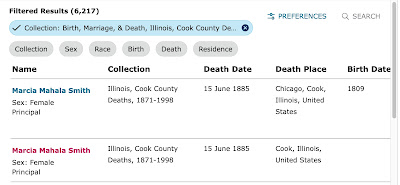
 As you can see above, the index is alphabetical with both brides and grooms listed and it provides the name of the spouse, a date, and a serial number.

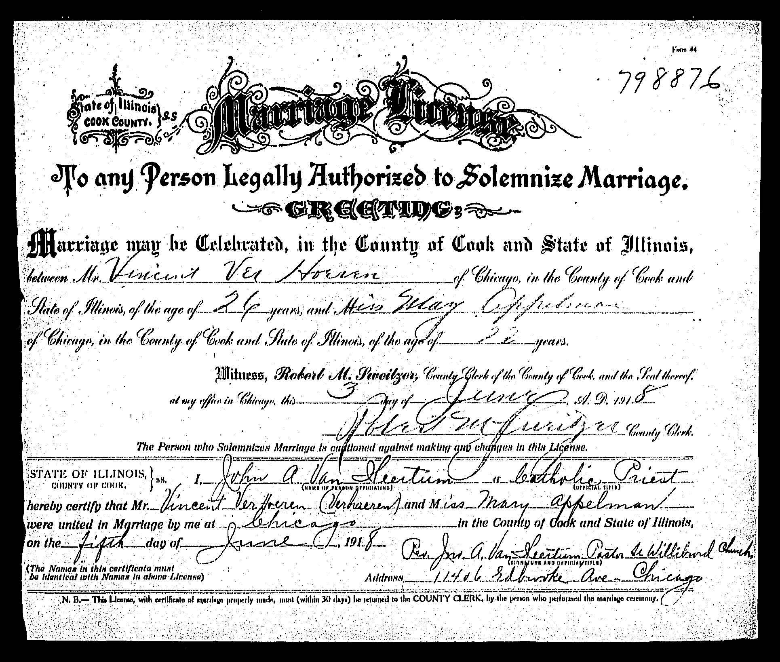
Comparing an entry with a marriage license (I chose Mary Appelman) suggests that the date is the marriage date (not the date the license was issued) and the serial number is the license number.


I can see a few ways that this index would be useful.

  1. If you find a 1921-1924 marriage listed here, it's pretty certain that a $15 search request to the county will result in a "found" result.
  2. If you can't find a marriage through 1920 at FamilySearch but can find the name here, it's likely that the license is online, just indexed in an interesting way. Keep looking. Search the Ancestry index by date, use other names to enter the FamilySearch database and then browse forward or backward to find the right license number.
One caution. The marriage indexes to 1916 available on FamilySearch microfilm include entries for licenses that weren't returned and so it can't be assumed that a couple married just because their names are in those indexes. (On the other hand, it's also not possible to assume that they didn't marry; it's possible the officiator simply forgot to send the license back to the clerk's office.) It would be tempting to use this new index to confirm a couple's marriage, but it's probably not wise without knowing how the index was created.

Tuesday, November 01, 2011

Sam Fink's Marriage-Death Index Available on Ancestry

A client let me know that Sam Fink's Index, a very useful pre-Fire research tool, is now online at Ancestry under the title Cook County, Illinois Marriage and Death Indexes, 1833-1889. Great news! Think of it as a newspaper index to marriages 1833–1871 and a newspaper index/mystery source index to deaths 1833-1889.

In this post I'll tell you a little bit about the man who compiled the index and share tips on how to use the marriage and death index entries to find further information.

Sam Fink

So, who was Sam Fink and why did he go to so much effort to make an index of Chicago marriages and deaths? Sam Fink was "an attorney who made his living as an investigator and genealogist." ("Sam F. Fink: 88, Expert in Probate Investigation," Chicago Sun-Times, 7 February 1999; image copy, GenealogyBank (www.genealogybank.com : accessed 6 January 2022).) He was a professional researcher who dealt "exclusively with problems of determining the true and lawful heirs in estate matters, trusts, dormant bank accounts, and insurance policies." (Genevieve Flavin, "How to Hunt Your Heritage," Chicago Tribune, 22 March 1972, sec. 2, p. 4, cols. 6-7; image copy, Newspapers (www.newspapers.com : accessed 6 January 2022). He probably created this index as a tool to use in his work.

Marriage Index

The marriage index lists the names of the bride and groom, the date of the newspaper announcement, and a code for the newspaper that it appeared in. There are matching entries for both bride and groom so it doesn't matter which name you search. (If you can't find a newspaper article using information from one entry, search the corresponding entry to see if the information  the same. It would have been easy for the typist to make a mistake.)

Marriage Index Example
These entries are also included in the Illinois Statewide Marriage Index. They show "Fink" in the license number field but don't provide the newspaper code.

Illinois Statewide Death Index Example


So, what do you do once you've found a match in the index? First, use the code to determine the newspaper title(s). Then search out the matching article.

Chicago Tribune *
Chicago Times %
Chicago Evening Journal $
Chicago Democrat #
Chicago Democratic Press #
Chicago Evening Post ?
Chicago Record-Herald "
Chicago Daily News @
Chicago Examiner ¢
The Inter-Ocean :

If you're in the Chicago area, these newspapers can be found on microfilm at the Harold Washington Library. Just take the L and get off at Library--State and Van Buren.

The Chicago Public Library website has some very helpful online information about local newspapers including a link to a timeline from the Encyclopedia of Chicago--which papers were published when--and a list of holdings with information on how to request obituary searches through your library's interlibrary loan department.

Chicago newspapers are also available at the Abraham Lincoln Presidential Library in Springfield. More information can be found on their Newspaper Microfilm Collection page. If you don't have easy access to the papers, Molly Kennedy, a researcher on our Genlighten.com site, offers newspaper searches with quick turnaround.

And some of the papers are online. The Chicago Tribune can be found at Fold3.com and ProQuest's Chicago Tribune Historical Archives is available through many libraries. GenealogyBank.com offers the newspapers listed below. Unfortunately, it doesn't seem to be possible to browse the pages and sometimes I find it hard to pull up matching entries using the name search.

Chicago Daily Times (1/16/1855 - 5/2/1856)
Chicago Herald (1/1/1890 - 12/31/1891)
Chicago Times (11/2/1854 - 7/3/1888)
Conservator (11/18/1882 - 12/18/1886)
Daily Inter-Ocean (2/15/1874 - 12/31/1896
Inter Ocean (6/5/1879 - 3/6/1896)
Pomeroy's Democrat (1/6/1869 - 2/15/1879)
Sunday Times (10/10/1869 - 12/31/1876)
Vorbote (2/28/1874 - 12/23/1876).

Death Index

Sam Fink's death index is divided into four sections: 1833-1874, 1875-1879, 1880-1884, and 1885-1889.

Death Index Example


Like the marriage index, many of the death index entries include a newspaper date and a code to tell you which title to check. An example would be the entry for Albert Francis Bullook below. Mention of his Albert's death occurs in the 6 Jul 1879 of the Chicago Tribune.

When you use the index you'll notice that some of the later death entries list a name, a volume, and a page number. Some entries, like the one for Mary Wilhemina Bulicek, include a volume and page along with newspaper codes and some, like the one for Mary Bull just provide a volume and page number.

The notes at Ancestry say "When the death entries came from Cook County death records, they list only a name and a volume and page number." The question is, what "Cook County death records" do these numbers refer to? I have an idea and I will follow up to see if I can learn more the next time I'm downtown. In the meantime, though, I don't believe they refer to the early register books held by the Cook County Clerk's Office. Those volumes were distinguished by letters.

So, how do you find a death certificate or a newspaper death notice when there's no newspaper date given? Here's one approach:

Volume numbers and the death dates they cover

1) First, check the key above to determine an approximate year of death. Mary's record is in volume 1 so her death was recorded between January of 1878 and August of 1879.

2) Next, search the Illinois Statewide Death Index for a matching entry. The likely match for Mary is listed under Wilhelmina: BULICEK, WILHELMINA 1879-07-03 CHICAGO 05 YR U 00003846

3) Use the death date as an entry point to searching newspapers. In this case the death notice was on page 8 the day after Mary's death.

If no newspaper code is given, follow the steps above to estimate the year of death and search the Illinois Statewide Death Index. Then use the information from that index to locate the death record on Family History Library microfilm or in the database at FamilySearch. 


Thursday, October 27, 2011

Cook County Naturalization: Stories from the Chicago Tribune

Many years ago, I remember seeing a picture of newly naturalized citizens in our local upstate New York newspaper. They were smiling, maybe even holding flags, and I sensed that they had just done something meaningful and significant.  I've always thought of my naturalized ancestors approaching the process in the same sort of way.

It wasn't until I did a search for "naturalization" in the Chicago Tribune Historical Archives that I realized there might be more to the story than a person's driving desire to become a citizen.

In October 1858, for example, the Chicago Tribune was encouraging two groups of individuals to naturalize--men of age who had arrived under the age of eighteen five or more years previous (they could naturalize immediately without filing first papers) and men who had filed declarations two or more years previous so that the waiting period to file the final papers had passed.

Why? Because the 1860 presidential election was coming up and the paper was eager to enroll more Republican voters. "Those who intend to vote the Pro-Slavery ticket need not apply for our assistance," the paper wrote. [1]

So what have I learned from the newspaper about the naturalization process in Cook County and what does it have to do with family history research?

1. Political parties encouraged aliens to naturalize as a way of increasing their voter pool. An October 1880 newspaper tells the story of an 81-year old Irish man who completed the naturalization process forty-nine years after he took out his first papers. The newspaper suggested that political party members "drew the octogenarian from his home and coax him to become a citizen so that he may help to diminish by one the minority for Hancock." [3] If your ancestor naturalized long after he was eligible, he might have received a little bit of outside encouragement.

2. If your ancestor naturalized in October, he might have been caught up in "The Naturalization Mill." In October of 1873 the Criminal Court was "working out citizens faster than a sausage-machine turns out sausages." [2] In October of 1880 the newspaper wrote, "the work of converting the subjects of foreign Kings, Emperors, or other potentates into citizens of the Great Republic is being very briskly carried on in all the courts of the city." [3] There were four courts that handled naturalization in Cook County early on--Circuit, County, Criminal, and Superior--and they sometimes held evening hours in order to accommodate the large numbers of people hoping to naturalize. If you look at the indexes (available on Family History Library film) you can see the entries swell during fall voter registration pushes.

3. The laws were sometimes bent. An 1873 article suggests "perjury is practiced with impunity" and that many of the men who naturalized were "no more entitled to vote than a citizen of Timbucktoo." [2] If you find  a naturalization record with a date that seems to be too soon after the arrival date for your answer, don't rule it on on that basis alone. It also seems that many found it convenient to state that they had arrived a minors to avoid filing first papers. An 1880 article states "A very singular feature was that so many of the applicants claimed to have come to this country while minors under 18 years of age. It would seems as though Ireland, Norway, Sweden, and Germany must have lost all their boys about six or seven years ago." [4]

4. And then there was downright fraud.  In December of 1873, a man who worked in the Criminal Court office, was convicted of issuing fraudulent naturalization papers to allow a fellow saloon-goer to vote. In this case, however, the man with alien status had no desire to vote illegally--it was the clerk who had initiated the process for him--and it was the clerk who was arrested. [5]

The Chicago Tribune published numerous articles on naturalization in the early years and if the subject interests you, I'd encourage you to browse the newspaper on the topic. If you come up with a find worth sharing, please post a comment.

_____________________________________

[1] ""Get Naturalized this Week." Chicago Press and Tribune (1858-1860): 0_1. ProQuest Historical Newspapers: Chicago Tribune (1849-1987). Oct 27 1858. Web. 27 Oct. 2011 <http://search.proquest.com/docview/168720474?accountid=6327>.

[2] "Local Politics." Chicago Daily Tribune (1872-1922): 4. ProQuest Historical Newspapers: Chicago Tribune (1849-1987). Oct 30 1873. Web. 27 Oct. 2011 <http://search.proquest.com/docview/171440065?accountid=6327>.

[3] "Naturalization Papers." Chicago Daily Tribune (1872-1922): 6. ProQuest Historical Newspapers: Chicago Tribune (1849-1987). Oct 27 1880. Web. 27 Oct. 2011 <http://search.proquest.com/docview/172289066?accountid=6327>.

[4] "Naturalization." Chicago Daily Tribune (1872-1922): 6. ProQuest Historical Newspapers: Chicago Tribune (1849-1987). Oct 28 1880. Web. 27 Oct. 2011 <http://search.proquest.com/docview/172275293?accountid=6327>. 

[5] "Fraudulent Naturalization Papers." Chicago Daily Tribune (1872-1922): 3. ProQuest Historical Newspapers: Chicago Tribune (1849-1987). 1873. Web. 27 Oct. 2011 <http://search.proquest.com/docview/171460741?accountid=6327>.

Monday, September 19, 2011

John S. Allen: Violin Maker


Today's post isn't about Chicago but it's about genealogy and another subject dear to my heart--fiddles and the people who make and play them. A few weeks ago a bit of insomnia brought me a couple of satisfying research finds, both fiddle-related, and today I thought I'd share one of them.

John S. Allen

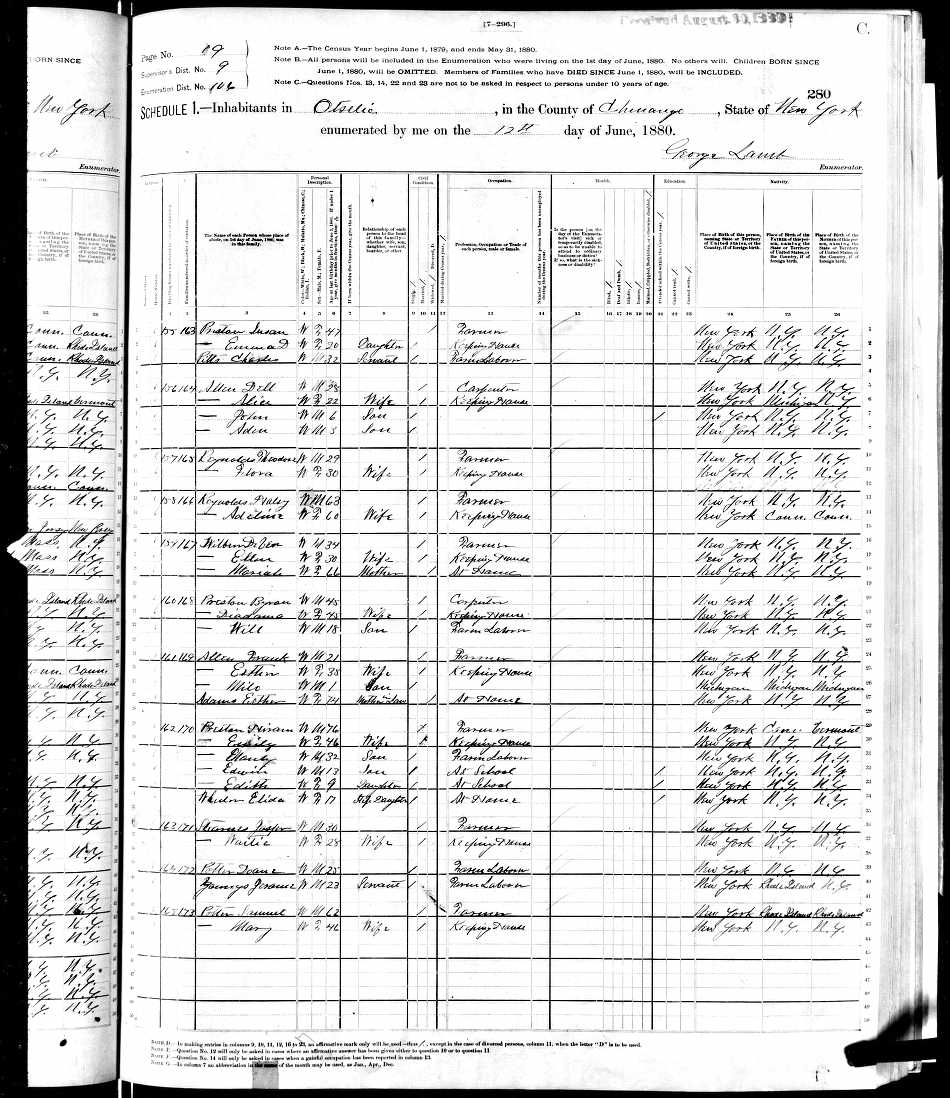
On December 23, 2008, a fellow fiddler started a discussion on Fiddle Hangout titled "Who was John S. Allen?" I spent the holiday trying to answer that question. I knew that Mr. Allen had studied violin making with J. B. Squier in Boston, probably in the 1890s, and I knew that he had some connection to Battle Creek, Michigan, most likely moving there to work with Mr. Squier's son, V. C. but that was all I knew. Without an age or birth place or parent or sibling or spouse--some little something in addition to the name--I exhausted most all of the options I had and finally gave up the search.

Recently a Fiddle Hangout member who had seen the archived thread sent me some information on the Squiers and somehow in that I-can't-really-explain-what-prompted-me-to-do-that sort of way, I typed "john s allen" into FamilySearch. I glanced at some Michigan death results, clicked through on a few, and all of a sudden found myself staring at a name and an occupation: John S. Allen, violin maker. He died of meningitis in Mason, Cass, Michigan on 9 Mar 1901.

I don't know that this is the right man, but I think there's a very good chance that he is.

1) This man was born in New York. It's reasonable to think he might have learned his craft from a Boston master.

2) He died at the age of 26. That would explain why so little seems to be known about him. He didn't live long enough to become a well-known maker.

If this is the right man, then one of the violins he made, number 58, was finished in 1896 when he was a pupil of Mr. Squier. If the death certificate is correct, John was born in 1874 which means he would have been 22 at the time.

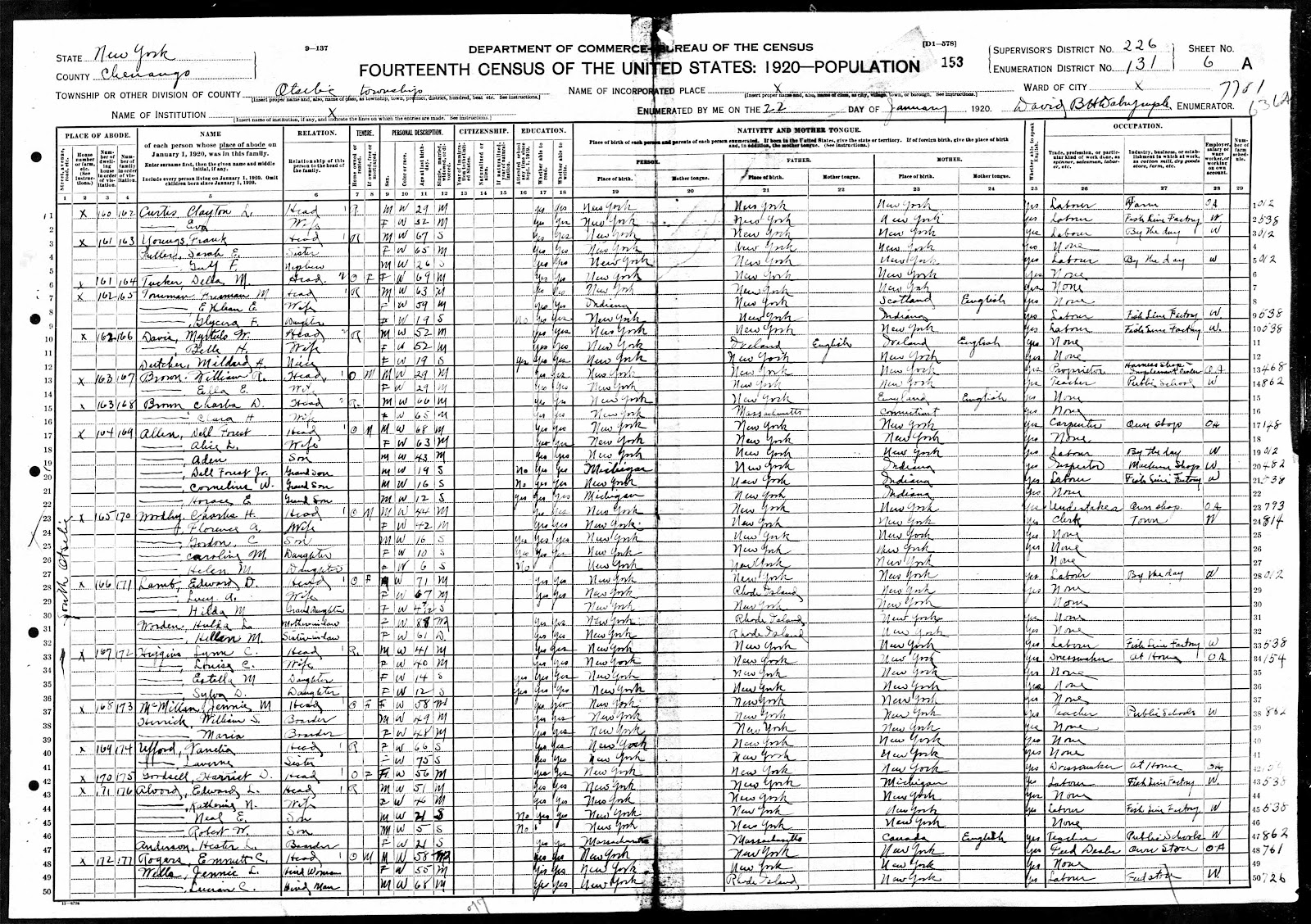
Further research tells me that John and his wife Pearl had a son Dell F. Allen, born 16 Dec 1900 in Mason. In 1920 Dell was living with his grandparents, Dell Forest and Alice L., in Chenango County, New York. The Social Security Death Index suggests that he died in Colorado in August of 1955.

Perhaps someday I'll find the time to learn more about Mr. Allen and his violins. If you happen to play one or if you happen to know the family, I'd love to hear from you.


Related census images


Saturday, September 17, 2011

Now Online: Chicago Catholic Church Records to 1915


You can now browse Archdiocese of Chicago Catholic church records online for free at FamilySearch and because the Archdiocese includes nearby towns, you will also find records for places like Oak Park, Evanston, and Cicero.

To access the images, you'll need to log into FamilySearch but if you don't already have an account, no worries. It's quick and easy to sign up and it's free. To find the images, go to FamilySearch, click on "US, Canada, and Mexico" under "Browse by Location," and scroll down to "Illinois, Chicago, Catholic Church Records, 1833-1925."

These records were digitized from Family History Library microfilm and even though the date in the title goes to 1925, you'll find that the records for most parishes end with 1915. That was the cutoff year when the records were filmed.

So, here are some tips for accessing the records.

1) Many of the books have index pages in the front.

2) If you're not sure which parish to search, locate the family's address in a city directory or on another record, a birth certificate, for example. Then use that address with the search tool at ChicagoAncestors.org to find out which parishes were close to the address.

3) If you're looking for a marriage register entry, find a copy of the marriage license first. Many will list the parish name. If the record doesn't, find the priest in a city directory to see where he was serving, or if it's an early marriage, try searching my priest/parish database for ideas.

4) It's helpful to narrow parishes by ethnicity. I usually use the list at POINTers in Person for that purpose.

Eventually, these records will be indexed, but in the meantime, happy searching.

Wednesday, September 14, 2011

Indexing Chicago Catholic Church Records: Tip for Reading Polish Surnames

As I mentioned in my previous post, I'm determined to contribute some time to indexing Chicago's Catholic parish records because I think it will create a much-needed resource for pre-Fire research and this morning I'm working on a page from a Polish church.
I'm familiar with the records and I've even bumped into a lot of Polish surnames in 5+ years of working with Chicago vital record searches but I'm still struggling to read some of the names.
This morning I was puzzling over the surname in this entry:
The "kowiak" was clear but was the surname really Autkowiak? It just didn't feel right.
I went to the Polish Genealogical Society of America (PGSA) website and pulled up the Dziennik Chicagoski Death Notice Index Search 1890-1929. I typed "kowiak" in the surname box, chose "wild card search" and hit enter. In this case, the answer to my question was on the first page of results.
Antkowiak. Of course! I know that "n" and "u" are often misread but it's so easy to forget when I'm reading names that are unfamiliar.
I suspect this database will prove to be a huge help as I work at accurately transcribing other names.
If you have other insights that will help make this project easier for other indexers, please post them as comments.

Thursday, September 08, 2011

FamilySearch's Chicago Catholic Church Record Indexing Project: Please Help

Yesterday I learned from the IL-COOK-CHICAGO-L mailing list that FamilySearch has begun a project to index Chicago's Catholic church records. The project title is

US, Illinois, Chicago—Catholic Church Records, 1833–1910 [Part A]

and the resulting index will give us powerful new ways to access these records.

Why is the project so important? Just off the top of my head . . .

1) It will create an index to pre-Fire Catholic deaths.

2) It will create a multi-parish index to pre-Fire Catholic births.

3) In many cases it will alleviate the need to try to guess a baptismal parish using a family’s address (which often doesn’t work)

4) It will be a useful tool for locating baptisms that took place in a parish
that wouldn’t have been the “logical” choice.

I don’t have a lot of free time—we are working very hard to meet our goal of having the new version of Genlighten.com ready for public beta by the site’s two-year anniversary this coming October—but I will do my best to contribute.

One of the things I’ve noticed searching for Chicago death records at FamilySearch is that there transcription errors that sometimes make it hard to pull records out of the database. This is inevitable, completely understandable, and I’m grateful to indexers who did their absolute best to decipher those hard-to-read records. But, as this new project begins, I’d encourage Chicago researchers who have experience working with the Catholic records and a familiarity with Chicago surnames to join in the project. I’m thinking the more pages that are indexed by people from the Chicago research community, the better the index will be.

And to that end, I’ve been thinking how much fun it would be to have a FamilySearch indexing party. I picture friends gathering around a table, laptops plugged in, batches downloaded and ready to go. Along with the clicking of computer keys, there’d be the occasional, “Please pass the chocolate-covered cashews?” and “Can anyone tell what this letter is?” Have any of you ever tried that? Was it fun?

Using the Family History Library Record Lookup Service

Have you heard about the Family History Library Record Lookup Service? It's a very convenient way to obtain digital copies of Chicago vi...