Friday, May 27, 2011

Face to Face with a Marriage License Clerk

It's funny how things happen.

This morning my husband was reading The Ancestry Insider and the blog post linked to a FamilySearch Wiki entry titled "Gretna Greens in the United States" and he sent me the link.

I knew I'd seen articles in the Chicago Tribune about the topic so I logged into Footnote.com and did a quick search and suddenly found myself face to face with Cook County's "Marriage License Clerk Salmonson." Did you ever wonder what the County Clerk's office was like at the turn of the century? Take a look at this photo and imagine yourself next in line to get a marriage license. "Name? How do you spell that? Residence? Age?" Peer into the photo below to see the clerk's office through your ancestors' eyes.

I've often wished that I could talk to some of the clerks from days gone by. I'd love to ask them about the records that they kept--how they were created and organized and stored. This is kind of a next best thing.

The article is from The Chicago Tribune, 27 April 1902, p. 56 and I located it using Footnote.com. Click on the image to enlarge it to full size.

Chicago, by the way, was a popular place for eloping couples to marry. And if you're looking for a "Chicago" marriage that's nowhere to be found, try places like St. Joseph, Michigan (Marriage Index, 1889-1925) and Lake County, Indiana (Indiana Marriage Collection, 1800-1941 at Ancestry.com).

Saturday, March 05, 2011

Are Sources Ever Really Exhausted?

An email from a blog reader a little over a week ago got me wondering. How many valuable records are there out there that we don't search for because we don't know they exist?

A number of years ago I discovered the Minnesota Historical Society has a collection of papers from James A. Smith, my husband's ancestor. It was an exciting find and I immediately called to see if I could get photocopies of everything in the file. I gave them my debit card number and waited for the envelope. Nothing came and I thought, "Oh, well."

And then a box arrived--a box with three or four inches of paper and a receipt for more than I usually pay for a week's worth of groceries. I was a bit poorer than I had expected to be but I was elated. Most of the papers documented activities of the Northwest Fur Company in the mid-1860s (James was a partner) but there were also some land records and other miscellaneous items.

A few years later I was able to go to the Minnesota Historical Society in person and I found myself with a few extra hours at the end of my visit. I asked for the box of James A. Smith papers thinking that it would be fun to see the original documents. Looking through the files I noticed a folder with family letters. Family letters? When I got my bearings I realized that the folder contained correspondence between my husband's ancestor and his ancestor's brother--letters written in 1835 at the time that James A. Smith first came Chicago. Those letters hadn't been included in the box of photocopies that I'd received and they answered many of the questions that I had about the Smith family's decision to settle in the west. Finding those documents was moving and memorable.

Last week I heard from a researcher, Elliott Malkin, who had a similar Chicago-related experience. He had researched his great-grandfather's life in depth and thought that he had exhausted all of the available sources until he received an email from the granddaughter of his great-grandfather's third wife. It's a great story and I asked him if I could share the link.

Read Hyman Victor Revisited. It's a wonderful example of genealogical serendipity and collaboration. And then, once you've finished the blog post, click on the "my website about his life" link to visit the website that Mr. Malkin created to document his grandfather's life. It's a very nicely done.

Wednesday, January 12, 2011

Genealogy-Related Focus Group Opportunity in Chicago

If you live in the Chicago area and would be interested in participating in a paid genealogy-related 2.5 hour "market research discussion" organized by Schlesinger Associates on January 31 or February 1, email me and I'll send you the flyer.

This is not related in any way to ChicagoGenealogy.com or Genlighten.com. In fact, I didn't even qualify to participate! I received an email from Schlesinger Associates and offered to help get the word out.

I'm guessing, though, that it might be related to a post on the FamilySearch Facebook page yesterday asking for participants for a focus group in New York City. But, it's just a guess.

Thursday, December 30, 2010

Finding Chicago Naturalization Records

I was looking at FamilySearch’s historical records section over the holidays and noticed that the Soundex cards for Cook County naturalization were added on December 22. Now that they’re online for free, it seems like a good time to talk about Cook County naturalization research.

In this post, I’ll focus on finding the records, but I’ll try to share some of the interesting things I’ve discovered about the Cook County naturalization process in another blog post soon.

If you're looking for Chicago and Cook County naturalization records you'll want to begin with the Soundex index to naturalization petitions for U.S. District & Circuit Courts, Northern District of Illinois and Immigration and Naturalization Service District 9, 1840-1950. (I just call it “The Soundex Index.”) It’s the same as NARA publication M1285 and it includes entries for people who naturalized in northern Illinois, northwestern Indiana, southern and eastern Wisconsin, and eastern Iowa.

Online Access to the Naturalization Soundex Index

There are two places to access the index online. If you have an Ancestry.com subscription you can search the cards by name, year of birth, year of arrival, and state of residence in U.S. Naturalization Record Indexes, 1791-1992 (Indexed in World Archives Project.

If you don’t have an Ancestry subscription, you can now browse the cards for free at FamilySearch.org. They’re included in the historical records part of the site in a database called Illinois, Northern District Naturalization Index, 1840-1950.

Browsing the Soundex Images

Here’s my approach to browsing the images:

1) Use the Soundex converter at Rootsweb to find the correct Soundex code. Type in the surname, hit the "Get Soundex Code" button and you're done.

2) Select the correct Soundex range from the choices available at FamilySearch. (The link in this paragraph will take you to the correct part of the FamilySearch site.)

Example: B-653 Tekla to C-124 means that section will include B-653 surnames with given names starting with Tekla and run through the end of the C-124 given names.

3) Find a card with the correct given name using a high-low number game strategy. There are 6586 cards in the section that would include Charles Berman (B-655). I'd type 3000 in the image number box to get my bearings. The corresponding card is B-656 with a G given name so I'd try a lower number. Typing in 1500 brings up a card for B-655 with a J given name so I'd try again. Typing in 700 brings up an A given name for B-655. The number 900 brings me to a B-655 card with the name Charles John. If I chose that as my starting point I'd page through the images going backwards until I had exhausted the entries for Charles or similarly-spelled names and then I'd return to image 900 and page through going forward if I hadn't found the match.

The introductory pages to this index remind researchers not to overlook "initials, alternate spellings, and "old country" versions of names." Good advice.

Locating the Naturalization Records

Once you’ve found a card and saved it to your computer, you’re ready to locate a copy of the corresponding naturalization record. Check the court. If it says Circuit, County, Criminal, or Superior, the original records are at the Circuit Court Archives. If it says District, the original records are held by NARA. Records from all the courts are also available on Family History Library microfilm.

1. Circuit Court Archives

I can suggest four ways to get naturalization records from the Circuit Court Archives.

In Person: The Circuit Court Archives has the Cook County Naturalization records from the Circuit Court, County Court, Criminal Court, and Superior Court. If you live in the Chicago area, you can visit their office on the eleventh floor of the Daley Center to view the records (free) and obtain photocopies (minimal fee). The office is easily accessible from the L and the staff is very helpful and friendly.

By Mail: If you can’t visit in person, you can request the records by mail, but it’s a two-step process. Once you submit the order form the office will bill you for the copies and then send them out when payment is received. The cost is $2.00 for the first page and $.50 for each one thereafter (a naturalization record would have just a few pages at most) + a $15 mailing fee + postage.

Important Information to Read Before Requesting a Search

Mail-in Request Form

From Family History Library Film: Using the new catalog at FamilySearch, pull up records for “Cook, Illinois” and then narrow the search by clicking on the link for Naturalization and Citizenship. This will bring up a list of available records and once you’ve identified the correct reel you can order it in at your local Family History Center.

From a Local Researcher: If you don’t live in the Chicago area, it might be quicker and/or easier to request a lookup from a local researcher rather than ordering by mail or ordering FHL films. I can retrieve naturalization records at the Circuit Court Archives if I’m going downtown (send me an email) or KimStankiewicz offers the service through our Genlighten.com website.

2. National Archives and Records Administration’s Great Lakes Regional Archives

If the court is listed as District, then the original records are kept at the National Archives and Records Administration’s Great Lakes Regional Archives, 7358 S. Pulaski Road, in Chicago.

In Person: If you’re going to go in person, contact them ahead of time to double-check the search procedure. I have next-to-no experience doing research at NARA but it took a couple of visits for my husband retrieved a naturalization record for someone last year.

NARA Naturalization FAQ

By Mail: NARA’s website says that naturalization records must be obtained by written request and that it can be done in person or by mail, fax, email, or online. I tried the online ordering link earlier today (4 Jan 2011) and it wasn’t working so I couldn’t learn more about how that process works. The fees page on their website suggests that there’s a charge of $.75 each for record copies and that there’s a minimum $15 fee for mail orders.

From FHL Film: The District Court naturalization records are available on Family History Library microfilm. If you have access to a Family History Center you can order in the reels and obtain the records that way. Here’s a quick link to the film numbers up through 1947.

From a FHL Researcher: If you don’t have access to a Family History Center or if you’d like quick access to digital copies of the naturalization records, jorgfe offers that lookup on our Genlighten.com website.

This post has grown much long and taken much longer than I expected to write and so I'll wrap things up with a couple of links to not-to-be-missed pages.

Important Information About Cook County Naturalization Records (learn what kinds of information you can expect to find depending on the year the naturalization papers were filed)

Cook County Naturalization Declarations of Intention Index (search the declarations index online)

Tuesday, December 21, 2010

Stockyards Fire Anniversary: Who Died in the Fire 100 Years Ago?

An article by Becky Schlikerman on the Chicago Tribune website--100 years since Stockyards fire raged--caught my eye this morning and turned my attention to a fire that happened in the city's stock yards one hundred years ago tomorrow. The fire marshal, James Horan, was killed in the blaze and his descendants will commemorate the anniversary of the tragedy with a wreath ceremony.

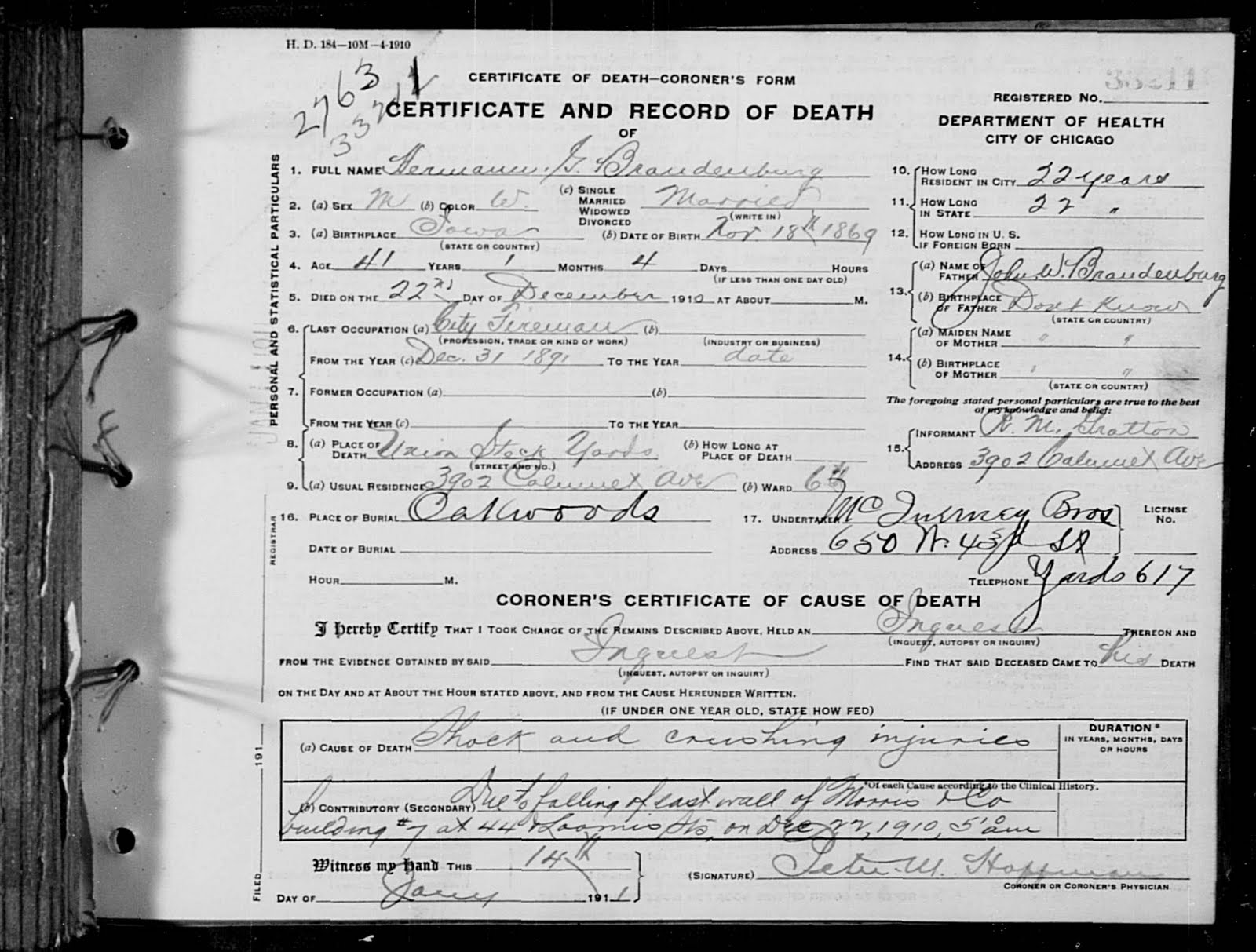
Mr. Horan's death certificate is available at FamilySearch and we can learn a lot about him from that record. He was born in Chicago in 1859, the son of Irish immigrants, and he had served the city as a fireman just short of thirty years at the time of his death. Notice how the names of the cemetery and undertaker are written. Is it possible that the family had a difficult time deciding where Mr. Horan would be buried? Or perhaps someone mistakenly wrote the wrong information and then corrected it? The informant, Daniel Horan, was Mr. Horan's brother and I can imagine him stepping in to help the grieving widow.


Today's article says that the fire "left behind 19 widows and 35 orphaned children" and I wondered who those unnamed people were. I searched the Chicago Tribune at Footnote.com and found several articles mentioning funerals for the men who were killed. Twenty-four people died as a result of the fire, twenty-three on December 22 and one on December 23. Twenty-one of them, members of the Chicago Fire Department, are memorialized on a monument at the Chicago Union Stockyards. Of the remaining three, two were "firemen" employed by Morris & Co.--Andrew Dymuran and Patrick Realph--and one was a messenger boy, Stephen Leen.

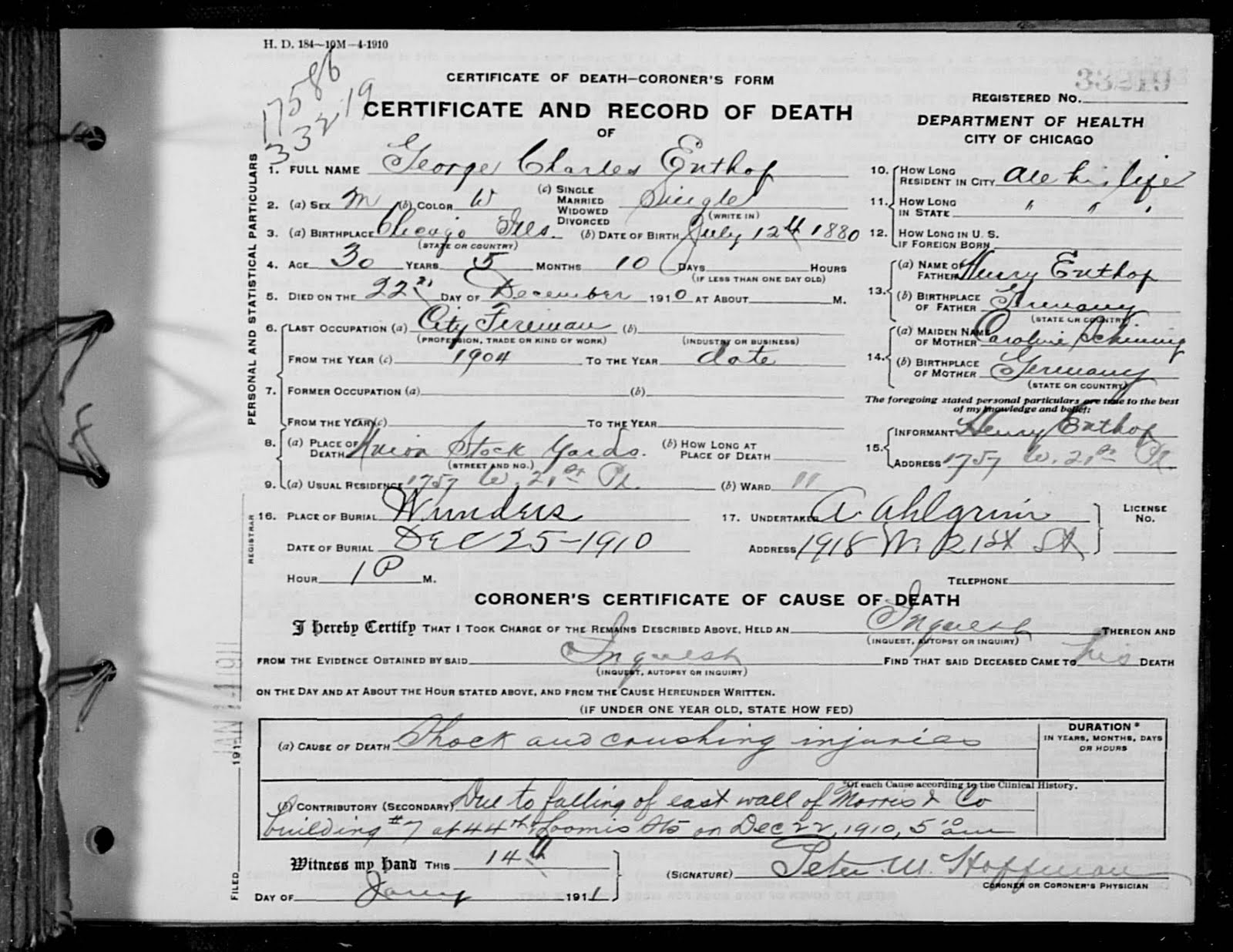
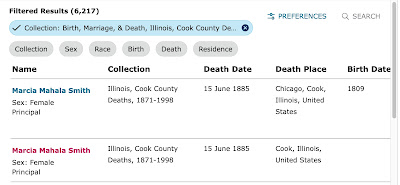
The Illinois Statewide Death Index entries for those who died in the fire are listed below. Click on the small images next to the death index entries to view the death certificates. (I located the records on FamilySearch using a database called Illinois, Cook County Deaths, 1878-1922).

BRANDENBURG, HERMANN G 1910-12-22 CHICAGO 41 YR 00001591

BURROUGHS, WILLIAM J 1910-12-22 CHICAGO 46 YR 00001592

COLLINS, PATRICK E 1910-12-22 CHICAGO 47 YR 00002883

COSTELLO, THOMAS J 1910-12-22 CHICAGO 30 YR 00002882

CRANE, NICHOLAS 1910-12-22 CHICAGO 36 YR 00002884

DANIS, EDWARD J 1910-12-22 CHICAGO 46 YR 00003820

DOYLE, DENNIS 1910-12-22 CHICAGO 51 YR 00003819

DOYLE, NICHOLAS D 1910-12-22 CHICAGO 27 YR 00003821

DYMURAN, ANDREW 1910-12-22 CHICAGO 23 YR 00003822

ENTHOF, GEORGE C 1910-12-22 CHICAGO 30 YR 00004369

FITZGERALD, JAMES J 1910-12-22 CHICAGO 31 YR 00005280

LANNON, ALEXANDER D 1910-12-23 CHICAGO 39 YR 00010632

LEEN, STEPHEN 1910-12-22 CHICAGO 16 YR 00010631

MCINERNEY, MICHAEL F 1910-12-22 CHICAGO 33 YR 00012830

MOORE, CHARLES N 1910-12-22 CHICAGO 28 YR 00021038

MORIARITY, ALBERT J 1910-12-22 CHICAGO 34 YR 00012040

MURASKI, GEORGE F 1910-12-22 CHICAGO 42 YR 00012039

POWERS, PETER J 1910-12-22 CHICAGO 34 YR 00014890

REALPH, PATRICK J 1910-12-22 CHICAGO 25 YR 00016424

SCHORSETTE, EDWARD D 1910-12-22 CHICAGO 27 YR 00018188

STURM, WILLIAM G 1910-12-22 CHICAGO 42 YR 00018189

WALTERS, FRANK W 1910-12-22 CHICAGO 57 YR 00021124

WEBER, WILLIAM F 1910-12-22 CHICAGO 35 YR 00021125

I haven't looked at these records carefully yet but it seems to me that each death certificate linked above will tell a story worth remembering--just like Mr. Horan's does.

_______________________________


If you're interested in learning more about the fire and its aftermath, the Chicago Tribune is a good place to start. Here are a few things that I learned as I searched through articles:

*Mourning clothes were provided to survivors free of charge by Charles A. Stevens' company. Employees went to the homes to take orders and measurements. (24 Dec 1910, p. 2, col. 6)

*Dennis and Nicholas Doyle were father and son. (24 Dec 1910, p. 2, col. 7)

*"Phone girls" handled a record number of calls during the incident. A number of them had relatives who died in the fire. (23 Dec 1910, p. 5, col. 6)

Thursday, December 16, 2010

Pre-Fire Sinai Congregation Marriages

It's quiet at the Wilmette Family History Center today and so I decided to explore the Chicago entries in the Family History Library catalog as a way of learning more about the new FamilySearch website.

One of the titles that caught my eye was Marriage and death records, 1861-1905 from Chicago's Sinai Congregation, Film 1013426, Item 16. The reel was available and so I decided to take a look.

The congregation's first service was held on 21 Jun 1861 and mention of it is made on the first page. The next page begins with January 1868 marriages and the entries seem to be numbered sequentially beginning with #91 and ending with #528. Following those entries there's a page that begins with marriage #1 from July 1861 (see the image) and the numbers then climb to #90. This means that there are approximately 150 pre-Fire marriages recorded in the book. It's a treasure of value to all of us but especially to those who have ancestors' names recorded there.

The register entries include the names of the bride and groom, the marriage date, and the marriage date according to the Jewish calendar. A few entries have additional information. For example, one mentions that the bride was from Valparaiso, Indiana and at least two others note that one of the parties was born Christian. Some previous civil marriages are also mentioned. The death entries seem few and hard to find but the one I saw provided the name of the deceased and a death date.

After looking through the book, I wanted to know a little bit more about the congregation and so I checked the 1870 Edward's Chicago City Directory (p. 931). At that time the Sinai Congregation was listed at "Van Buren street, corner Third avenue," one of five Jewish congregations in the city, and it had about 100 members.

The Chicago Sinai Congregation will celebrate its 150th anniversary in 2011. For more information about the congregation's history, visit their website.

The film says the original marriage and death book is held by the Jewish Archives in Cincinnati, Ohio.

Tuesday, November 30, 2010

Mother Reunited with Daughter: Chicago Daily Law Bulletin Follow-up

A blog reader noticed an entry in the Chicago Daily Law Bulletin image I included in a previous post that referred to "People ex rel v Superior of House of the Good Shepherd" and wondered about the details of the case. I decided to follow up and obtained a copy of the file.

It seems a writ of habeas corpus was filed by a man named Miles Martin on behalf of a child named Sylvia Lear who was living at House of the Good Shepherd as Minnie Bell Pursell. According to the document, "Sylvia was some years ago stolen from her mother and the parties who took her have since died and the child falling into other hands, at last was placed in said House of the Good Shepherd to avoid the care and Expense of providing for such child."

The petition continued: "...the mother of said Sylvia after diligent Search and Enquiry for her child she having the only lawful right and custody to the care Custody and Education of said child, at last found out, that her said daughter was confined in said House of the Good Shepherd and that she demanded her said child of the Mother Superior of said Institution and was refused as well that she might see [her?] child at all."

The judge wrote "Let the writ of habeas corpus issue pursuant to prayer of within petition." It was dated Jan. 3, 1880 but the year was actually 1881.

Reading through the document, I wondered about Sylvia. Who was she? What happened to her? I checked the Chicago Birth Registers, 1871-1915 at FamilySearch's Record Search thinking she might have been born in Chicago but no good match turned up. Then I checked the Cook County marriage index to 1920 thinking she might have stayed in Chicago and married, but no luck.

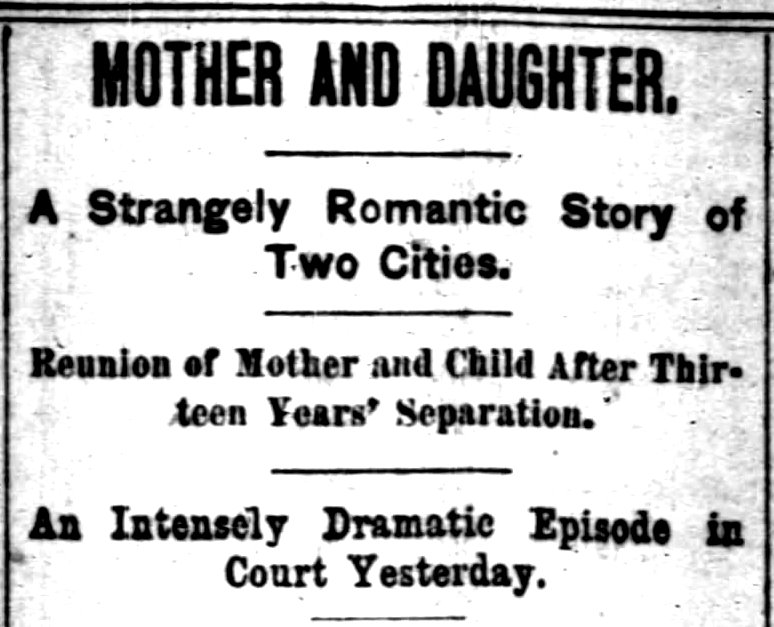
Then, I tried a search for "sylvia lear" in the Chicago Tribune at Footnote.com and found one match from 5 January 1881. I thought it would be a quick mention of the case in a legal column but the headline read "Mother and Daughter. A Strangely Romantic Story of Two Cities. Reunion of Mother and Child after Thirteen Years' Separation. An Intensely Dramatic Episode in Court Yesterday."

The lengthy report details the story of a young Peoria Christmas bride waiting for a groom who never came. Seven months later, July of 1868, she gave birth to a "female child" who was named Sylvia Lear and given to her married sister to raise. Four years later the young bride learned from her dying sister that the child had been left at a hotel in Peoria because her husband was unwilling to provide support. The baby was given to a woman named Ellen Kirby, who married Sanders, and later married Purcell. Mr. Purcell died. Mrs. Purcell died, and Sylvia ended up at House of the Good Shepherd. The story includes many more details than I have summarized her and it's worth taking the time to read it. Article Image

Sylvia's mother's name isn't mentioned beyond "Carrie" and "Mrs. W" in order to protect her privacy and, for the moment anyway, I think I will respect that. Still, I wonder what became of Sylvia Lear?

Using the Family History Library Record Lookup Service

Have you heard about the Family History Library Record Lookup Service? It's a very convenient way to obtain digital copies of Chicago vi...